The backstory: Steven Pinker wrote a book about rationality. The book concludes it is good. People should learn how to be more rational, and then we will have fewer problems.
Howard Gardner, well-known wrong person, sort of criticized the book. The criticism was facile, a bunch of stuff like “rationality is important, but relationships are also important, so there”.
Pinker’s counterargument is dubious: Gardner’s essay avoids rationality pretty carefully. But even aside from that, it feels like Pinker is cheating, or missing the point, or being annoying. Gardner can’t be arguing that rationality is completely useless in 100% of situations. And if there’s any situation at all where you’re allowed to use rationality, surely it would be in annoying Internet arguments with Steven Pinker.
We could turn Pinker’s argument back on him: he frames his book as a stirring defense of rationality against anti-rationalists. But why does he identify these people as anti-rationalists? Sure, they themselves identify as anti-rationalist. But why should he believe them? After all, they use rationality to make their case. If they won, what bad thing would happen? Even in whatever dystopian world they created, people would still use rationality to make cases.
I feel like what I’m missing is an idea of what anti-rationalism means. What’s at stake here? What are we arguing about when we argue about rationality?
Rationality As Full Computation Opposed To Heuristics?
I think Howard Gardner sort of believes this. He has an inane paragraph about how respect is more important than rationality. When I try to make sense of it, I get an argument kind of like: the Communists trusted their reason, reasoned their way into believing Communism was true, and oppressed people because their version of communism said it was okay. But they should have trusted a heuristic saying that every human being is worthy of respect instead.
Elsewhere in the essay, he compares rationality unfavorably to religion or tradition. One is tempted to use the maneuver from Pinker’s tweet here: “Is there anything good about religion or tradition?” If no, why prefer them to rationality? If yes, wouldn’t a rational person rationally choose to believe / follow them?
Again, this makes the most sense as an argument about heuristics. It’s the old argument from cultural evolution: tradition is the repository of what worked for past generations. Perhaps you are very smart and can beat past generations. Or perhaps you are an idiot, you think “I can do lots of cocaine-fueled orgies, because I will just calculate the pros and cons of each line of cocaine / potential sex partner as I encounter them, and reject the ones that come out negative”, and then one time you forget to carry the one and end up in a bathtub minus a kidney. This was basically how Communism went too.
One of the most common arguments against rationality is “something something white males”. I have never been able to entirely make sense of it, but I imagine if you gave the people who say it 50 extra IQ points, they might rephrase it to something like “because white males have a lot of power, it’s easy for them to put their finger on the scales when people are trying to do complicated explicit computations; we would probably do a better job building a just world if policy-makers retreated to a heuristic of ‘choose whichever policy favors black women the most.’”
So what are pro-rationality and anti-rationality people arguing about? In this model, Pinker and his supporters believe you should explicitly calculate the pros and cons of everything you do, whereas Gardner and his supporters believe you should often retreat to heuristics like “don’t do anything that violates human rights” or “live a holy and god-fearing life” or “don’t do drugs” or “try to favor black women”.
But I am pretty much 100% sure that Pinker and his supporters don’t believe the stupid explicit computation thing. I count myself among his supporters and I definitely don’t believe it. Obviously heuristics are important and good. This is true not just for big important moral things, but also for everyday occurrences and determining truth. If I get an email from a Nigerian prince asking for money, I’m not going think “I shall do a deep dive and try to rationally calculate the expected value of sending money to this person using my very own fifteen-parameter Guesstimate model”. I’m going to think “nah, that kind of thing is always a scam”. Not only will this prevent me from forgetting to carry the one and sending my life savings to a scammer, but it also saves me the hours and hours it would take to create an explicit model and estimate a probability.
Then maybe the difference between rationalists and anti-rationalists is that rationalists use heuristics sparingly and are willing to question them, and anti-rationalists follow heuristics religiously (or even slavishly)? But Gardner claims to be Jewish, and I doubt he follows all 613 commandments; I imagine he’s even raised his voice a few times when respect didn’t seem to be working. I think everybody follows some combination strategy of mostly depending on heuristics, but using explicit computation to decide what heuristics to have, or what to do when heuristics conflict, or whether a certain heuristic should apply in some novel situation.
Rationality As Explicit Computation Opposed To Intuition?
“Intuition” is a mystical-sounding word. Someone asks “How did you know to rush your son to the hospital when he looked completely well and said he felt fine?” “Oh, intuition”. Instead, think of intuition as how you tell a dog from a cat. If you try to explain it logically - “dogs are bigger than cats”, “dogs have floppy ears and cats have pointy ones” - I can easily show you a dog/cat pairing that violates the rule, and you will still easily tell the dog from the cat.
Intuition can be trained. Good doctors have great intuition, and are constantly saying things like “this feels infectious to me”. If you ask them to explain, they’ll give you fifteen different reasons it seems infectious, but also admit there are ten different reasons it might be iatrogenic and forty reasons it might be autoimmune, but the infectious reasons seem more compelling to them. A newbie intern might be able to generate the same list of 15 vs. 10 vs. 40 reasons and be totally paralyzed by indecision about which ones are most important.
This last decade has been good for intuition, because we’ve finally been able to teach it to computers. There are now AIs that can tell dogs from cats, previously an impossible task for a machine. There are style transfer AIs that can make a painting feel more like a Van Gogh, or “more cheerful”, or various other intuitive things. Even text generation programs like the GPTs are conquering intuition - Strunk & White aside, there’s no ruleset for how to write, just better or worse judgment on what word should come next. Since these AIs are just giant matrix multiplication machines, “intuition” now has a firm grounding in math - just much bigger, more complicated math than the usual kind that we call “logical”.
So in another conception of the debate, the Pinkerian rationalists want to explicitly compute everything through formal arguments or equations, but the Gardnerian anti-rationalists just want to get a gestalt impression and make an intuitive decision. This maps onto stereotypes about atheism vs. religion: the atheist saying “here are 7,000 Biblical contradictions, QED” vs. the believer saying “but it just feels true to me”.
But again, I would be shocked if Pinker or other rationalists actually believed this - if he thought it was a productive use of his time to beat one of those cat/dog recognition AIs with a sledgehammer shouting “Noooooooooo, only use easily legible math that can be summed up in human-comprehensible terms!” Again, it would be impossible to live your life this way. A guy with a gun would jump out from behind the bushes, and you’d be thinking “well intuitively this seems like a robbery, but I can’t be sure until I Fermi estimate the base rates for robberies in this area and then adjust for the time of day, the…” and then the robber has shot you and you probably deserved it.
Even this doesn’t go far enough - it suggests that intuition might only be useful under pressure, and when you have enough time you should do the math. But I recently reviewed the discourse around Ajeya Cotra’s report on AI timelines, and even though everyone involved is a math genius playing around with a super complex model, their arguments tended to sound like “It still just doesn’t feel like you’re accounting for the possibility of a paradigm shift enough” or “I feel like the fact that your model fails at X is more important than that my model fails at Y, because X seems more like the kind of problem we want to extrapolate this to.” The model itself is explicit, but every decision about how to make the model or how to use the model is intuitive and debated on intuitive grounds.
The idea has a history behind it. Newcomb’s Paradox is a weird philosophical problem where (long story short) if you follow an irrational-seeming strategy you’ll consistently make $1 million, but if you follow what seem like rational rules you’ll consistently only get a token amount. Philosophers are divided about what to do in this situation, but (at least in Yudkowsky’s understanding) some of them say things like “well, it’s important to be rational, so you should do it even if you lose the money”.
This is what Eliezer’s arguing against. If the “rules of rationality” say you need to do something that makes you lose money for no reason, they weren’t the real rules. The real rules are the ones that leave you rich and happy and successful and make the world a better place. If someone whines “yeah, following these rules makes me poor and sad and unable to help others, but at least they earn me the title of ‘rational person’”, stop letting them use the title!
This definition has its issues, but one thing I like is that it makes it very clear that following heuristics or using intuitions is fine.
If you have some difficult problem, should you consult your intuitions or your long chain of explicit reasoning? What would a rational person do? The most rational answer I can think of here is “run the experiment, try it both ways a few times, and use whichever one produces better results”.
Should you rely on heuristics, or calculate everything out each time? I would be surprised if people who explicitly calculated the value of responding to each spam email ended up happier and richer and psychologically healthier and doing more good in the world than people who click the “delete” button as a spinal reflex - in which case, a real rationalist should choose the reflex.
This has the happy side effect that it’s impossible to be against rationality. But it also has the more concerning implication that it’s vacuous to be in favor of it. If rationalists were people who really liked explicit chains of computation, we could print out cool “TEAM EXPLICIT CHAIN OF COMPUTATION” t-shirts and play nasty pranks on the people who like heuristics and intuition. But if it’s just about preferring good things to bad things, it doesn’t really seem like a method, or a community, or an ideology, or even necessarily worth writing books about.
It still feels like there’s something that Pinker and Yudkowsky are more in favor of than Howard Gardner and Ayatollah Khameini, even though I bet all four of these people enjoy winning.
Rationality As The Study Of Study?
Maybe rationality is what we’re doing right now - trying to figure out the proper role of explicit computation vs. intuition vs. heuristics. In this sense, it would be the study of how to best find truth.
This matches a throwaway line I made above - that the most rational answer to the “explicit computation vs. heuristics” question is to try both and see which works better.
But then how come pretty much everybody identifies “rationality” more with the explicit calculation side of things, and less with the intuitive side? Surely a generic study of truth-seeking would be unbiased between the two, at least until it did the experiments?
Geology is the study of rocks. It’s hard to confuse the object-level with the meta-level; rocks are a different kind of object than studying. If you’re debating whether a certain sample is schist or shale, you’re debating the rocks. If you’re debating whether argon-argon dating is more appropriate than potassium-argon dating, you’re debating the study. In order to do good science, you want your studying to conform to certain rules, but nobody expects the rocks themselves to conform to those rules.
Rationality is the study of truth-seeking, ie the study of study. It’s very easy to confuse the object-level with the meta-level; are we talking about the first or second use of “study” in the sentence?
Science ought to be legible, not because legibility is always better at finding truth, but because that’s part of the “rules” of science. You don’t get to say you’ve scientifically explained something until you’ve put it into a form that other people can understand. This is a good rule - once something is comprehensible, you can spread it and other people can build on it. Also, you’re more likely to be able to take it off in new directions.
If some prospector has a really amazing knack for figuring out where diamonds are buried, which he can’t explain - “This just feels like a diamond-having kind of area to me” - then he’s good at rocks but not good at geology. He’s not a geologist until he’s able to frame it in the form of laws and explanations - “diamonds are found in areas where deeper crust has been thrust to the surface, which can be recognized by such-and-such features”.
If you’re a mining company, then by all means hire the guy with the mysterious knack; employing him sounds really profitable. But a hundred years later, most of the progress in diamond-acquisition is going to come from the scientists (…is a hypothesis you could assert; I think Taleb would partly disagree). Not only can they share their findings in a way that Knack Guy can’t share his knack, but they can ask questions and build upon them - might there be other signs that indicate deeper crust thrust to the surface? Can we just dig down to the deep parts of the crust directly? Can we replicate the conditions of the deep crust in a lab, and avoid having to mine at all? These are the kinds of questions that a knack for finding diamonds doesn’t help with; you need the deep theory.
Likewise, supposing that some tradition is good, following the tradition will give you the right answer. But you can’t study it (unless you study the process by which traditions form, which isn’t itself “relying on tradition”). You’ve been magically gifted the correct answer, but not in a way you can replicate at scale or build upon. “Following the Sabbath is good because it helps you relax and take time to contemplate, the ancients were very wise to prescribe it”. Fine, but I need fifteen people to bond super-quickly in the midst of very high stress while also maintaining good mental health, also five of them are dating each other and yes I know that’s an odd number it’s a long story, and one of them is secretly a traitor which is universal knowledge but not common knowledge, can you give me a tradition to help with this? “Um, the ancients never ran into that particular problem”.
Sometimes theories lag way behind practice. For most of medical history, theorists believed bloodletting and the four humors, whereas people with knacks (wise women, village healers, etc) generally did reasonable things with herbs that presaged modern medicine. Still, even though ancient doctors got the contents of their theories wrong, the part where they had theories was legitimately a real advance; without it, I don’t think we would have gotten to modern medicine, which does outperform the wise women most of the time.
If you’re seeking truth, you’re absolutely allowed to do what Srinivasan Ramanujan did when he discovered how to simplify a certain kinds of previously unsolvable math problem:
It is simple. The minute I heard the problem, I knew that the answer was a continued fraction. ‘Which continued fraction?’ I asked myself. Then the answer came to my mind
If we define rationality as “the study of truth-seeking”, this is good at the “truth-seeking” part, but bad at the “study” part. He got the right answer. The truth was successfully sought, the diamond was found. But he can’t explain to anyone else how he did it - he just has a good knack for this kind of thing.
Here’s one scenario which I think is unlikely but theoretically possible: the formal study of rationality will end up having zero advantages over well-practiced intuitive truth-seeking, except insofar as it allowed Robin Hanson to design prediction markets, which someday take over the world. This would be a common pattern for sciences: much worse at everyday tasks than people who do them intuitively, until it generates some surprising and powerful new technology. Democritus figured out what matter was made of in 400 BC, and it didn’t help a single person do a single useful thing with matter for the next 2000 years of followup research, and then you got the atomic bomb (I may be skipping over all of chemistry, sorry).
I’m not actually that pessimistic. I think there are plenty of times when a formal understanding of rationality can correct whatever vague knacks people are otherwise using - this is the biases and heuristics research, which I would argue hasn’t been literally zero useful.
This theory would help explain how Pinker’s beef with Gardner developed. Gardner is making the same sort of claim as “wise women do better than Hippocratic doctors”. It’s a potentially true claim, but making it brings you into the realm of science. If someone actually made the wise women claim, lots of people would suggest randomized controlled trials to see if it was true. Gardner isn’t actually recommending this, but he’s adopting the same sort of scientific posture he’d adopt if he was, and Pinker is picking up on this and saying “Aha, but you know who’s scientific? Those Hippocratic doctors! Checkmate!”
A few weeks ago, when I posted my predictions for 2022, a commenter mentioned that various “rationalist” “celebrities” - Eliezer Yudkowsky, Julia Galef, maybe even Steven Pinker - should join in, and then we would find out who is most rational of all. I hope this post explains why I don’t think this would work. You can’t find the best economist by asking Keynes, Hayek, and Marx to all found companies and see which makes the most profit - that’s confusing money-making with the study of money-making. These two things might be correlated - I assume knowing things about supply and demand helps when starting a company, and Keynes did in fact make bank - but they’re not exactly the same. Likewise, I don’t think the best superforecasters are always the people with the most insight into rationality - they might be best at truth-seeking, but not necessarily at studying truth-seeking.
Medical training is a wild ride. You do four years of undergrad in some bio subject, ace your MCATs, think you’re pretty hot stuff. Then you do your med school preclinicals, study umpteen hours a day, ace your shelf exams, and it seems like you're pretty much there. Then you start your clinical rotations, get a real patient in front of you, and you realize - oh god, I know absolutely nothing about medicine.
I support effective altruism, a vast worldwide movement focused on trying to pick good charities. Sometimes I go to their conferences, where they give lectures about how to pick good charities. Or I read their online forum, where people write posts about how to pick good charities. I've been to effective altruist meetups, where we all come together and talk about good charity picking. So I felt like, maybe, I don't know, I probably knew some stuff about how to pick good charities.
And then I solicited grant proposals, and I got stuff like this:
A. $60K to run simulations checking if some chemicals were promising antibiotics. B. $60K for a professor to study the factors influencing cross-cultural gender norms C. $50K to put climate-related measures on the ballot in a bunch of states. D. $30K to research a solution for African Swine Fever and pitch it to Uganda E. $40K to replicate psych studies and improve incentives in social science
Which of these is the most important?
Part of my brain keeps helpfully suggesting "Just calculate how much expected utility people get from each!" I can check how many people die of antibiotic-resistant infections each year (Google says either 30K, 500K, or 1M, depending on which source you trust). That's a start! But the chance of these simulations discovering a new antibiotic is - 10%? 1%? 0.00001%? In silico drug discovery never works and anyone with half a brain knows that? The compounds being tested are dumb compounds? Even if they worked, bacteria would just develop more resistance in a week? Pharma companies would capture all the value from any new antibiotics and make it impossible for poor people to afford them? Five much better labs have already tried this and all the low-hanging fruit has been picked? Screening for new antibiotics is a great idea but actually it costs $4.50 and this is outrageously overpriced?
And that's an easy one. What about B? If the professor figures out important things about what influences gender norms, maybe we can subtly put our finger on the scale. Maybe twenty years later, women across the Third World will have equal rights, economic development will be supercharged, and Saudi Arabia will be a Scandinavian-style democracy with a female Prime Minister. But maybe the professor won't find anything interesting. Or maybe they will find something interesting, but it will all be stuff like "it depends what kind of rice they cultivated in 4000 BC" and there won't be any subtle finger-putting-on-scale opportunities. Or maybe the professor will find something great, but nobody will listen to her and nothing will happen. Or maybe Third World countries will get angry at our meddling and hold coups and become even more regressive. Or maybe we'll overshoot, and Saudi Arabia will become really woke, and we'll have to listen to terrible takes about how the Houthi rebels are the new face of nice guy incel misogyny.
Which is higher-value, A or B? Probably more women suffer under oppressive gender norms than people die of antibiotic-resistant infections, but dying is probably worse than inequality, and there's a clearer path from antibiotic -> recovery than from research paper -> oppressive countries clean up their act. What about second order effects? If women have more equality in Saudi Arabia, maybe an otherwise unrecognized female genius will discover a new antibiotic. But if we have more antibiotics, someone who would otherwise have died of a bacterial infection might liberate women in Saudi Arabia. Aaagh!
Part of my brain helpfully suggests "Do a deep dive and answer these questions! This is the skill you are supposedly good at!" Quantifying these questions sounds crazy, but I am nothing if not crazy for quantifying things. It could work.
…except that I had 656 applications like this, and everyone told me it was important to get back to people within a month or two. I don't think I could fully explore the subtleties of the antibiotic proposal in that time - let alone 656 proposals, most of which were even less straightforward.
II.
There’s a well-known solution to this kind of thing:
Just make a ballpark guess and then get on with your life.
The problem is: this grants program could be the most important thing I’ll ever do. Maybe everything else, all my triumphs and failures, will end up less important than getting this one grants program right.
GiveWell estimates that if you donate to their top charity, Against Malaria Foundation, you can probably save a life for about $5000. ACX Grants raised $1.5 million. Donated to AMF, that’s enough to save 300 lives. I didn’t donate it to AMF. I believed that small-batch artisanal grant-making could potentially outperform the best well-known megacharities - or at least that it was positive value in expectation to see if that was true. But if your thesis is “Instead of saving 300 lives, which I could totally do right now, I’m gonna do this other thing, because if I do a good job it’ll save even more than 300 lives”, then man, you had really better do a good job with the other thing.
Robin Dunbar claims that humans have a capacity to handle 150 social relationships. Count up my friends, family members, coworkers, and acquaintances, and there will probably be about 150 who I can remember consistently and have some vague emotional connection to. If I made some mistake that killed all those people - all my friends, relatives, everyone I know - then in some “objective” sense, that would be about as bad as screwing up this grants program in some way that made it only half as good as the malaria counterfactual.
This isn’t what really bothers me. My brain refuses to believe it, so I don’t really care. The part that really bothers me is that I know a lot of middle-class people who are struggling. Somebody who’s $10,000 in credit card debt, and it’s making their life miserable. Someone else who posts a GoFundMe for a $5,000 medical bill. Another person who’s burned out at their $40,000 a year job and would probably have vastly better health if they could take a few months off and then job-search from a place of financial stability.
If on average these people need $10,000 each, my $1.5 million could help 150 of them. Most of these wouldn’t literally save lives, but a few might - I saw a patient once who attempted suicide for want of $5,000. And it would sure brighten a lot of people’s years.
So: $60,000 could test some promising antibiotics, or fund a book on gender norms. But it could also cure twelve Africans who would otherwise die of malaria, or save 5-10 Americans struggling under dead-end jobs and unpayable debts.
I tried not to think too hard about this kind of thing; I’m nervous it would make me so crazy that I’d run away from doing any kind of charity at all, and then everyone would be worse off. Even more, I’m worried it would scare me into taking only the most mainstream and best-established opportunities, whereas I really do think a lot of value is in weird charity entrepreneurship ideas that are hard to quantify.
But I couldn’t push it out of my mind far enough to do a half-assed job on the grants round, which meant confronting some of those problems head-on.
III.
…by which I mean “passing them off to other people”.
All those effective altruism conferences might not have given me infallible grant-making heuristics, but they did mean I knew a lot of grantmakers. I begged the institutional EA movement for help, and they lent me experts in global poverty, animal welfare, and the long-term future. I was able to draw on some other networks for experts in prediction markets and meta-science.
There wasn't as ready-made an EA infrastructure for biology, so I jury-rigged a Biology Grants Committee out of an ex-girlfriend who works in biotech, two of her friends, a guy who has good bio takes in the ACX comments section, and a cool girl I met at a party once who talked my ear off about bio research. Despite my desperation, I lucked out here. One of my ex’s friends turned out to be a semiprofessional bio grantmaker. The guy from the comments section was a bio grad student at Harvard. And the girl from the party got back to me with a bunch of detailed comments like “here’s the obscure immune cell which will cause a side effect these people aren’t expecting” or “a little-known laboratory in Kazakhstan has already investigated this problem”.
These people really came through. Don’t take my word for it - trust the data. The five of their opinions correlated with each other at r = 0.55, whereas my uninformed guesses only correlated with them at r = 0.15. This made me feel much more confident I was picking up something real.
But even the “experts” weren’t perfectly aligned. There were three proposals where one evaluator assigned the highest possible rating, and another assigned the lowest possible. Sometimes these were differences of scientific opinion. Other times they were more fundamental. One person would say "This idea would let you do so many cool things with viruses" and another person would say "This idea would let you do so many cool things with viruses, such as bioterrorism".
Still, with their help I started to feel like I was finally on top of this.
IV.
Then I got the rug pulled out from under my feet again.
I was chatting online with my friend Misha about one the projects my Bio Grants Committee had recommended. He asked: given that they got funding from XYZ incubator a few years ago, why are they asking you for more funding now? XYZ incubator is known for funding their teams well, so they must have lost faith in these people. Some reports from a few years ago included the name of an impressive guy on their executive team, but more recent reports don’t mention him. The simplest explanation is that something went wrong, their executives expected rough going, their incubator got cold feet, and now they’re turning to a rube like you to help them pick up the pieces.
I was kind of flabbergasted. I had a very nice report from my Bio Committee telling me that all the science here was sound, the cells they were working with were very nice cells, etc. But here was a whole new dimension I hadn’t considered. Misha explained that he was an angel investor - not even some kind of super-serious VC, just a guy who invested his own money - and this kind of thing was standard practice in his field.
I’ll be honest. I know a lot of you are VCs. You read and support my blog, and I appreciate it. Some of the grant money I distributed came from VCs, which was very generous. But I always imagined you guys as kind of, you know, wandering into work, sipping some wine, saying “Hmmm, these guys have a crypto company, crypto seems big this year, I like the cut of their jib, make it so,” and then going home early. I owe you an apology. VC-ing is a field as intense and complicated and full of pitfalls as medicine or statistics or anything else.
As a grant-maker, I was basically trying to be a VC, only without the profit motive. But that meant I was staking $1.5 million on my ability to practice a very difficult field which, until five minutes previous, I hadn’t realized existed.
I solved this problem the same way I had solved my previous few problems: I begged Misha for help, and he agreed to serve on my grant evaluation team. But this kind of thing kept happening. Every time I thought I knew approximately how many different variables I needed to consider, my ship accidentally got blown off course into an entire undiscovered new continent of variable-considering, full of golden temples and angry cannibals.
I’m not going to write up the whole travelogue, but here are ten things worth thinking about if you’re considering a grants program of your own:
(1): Many applicants ask for a random amount of money, and it’s your job to decide if you should give more or less.
For example, I originally said my grants would max out at 50-100K, and many people asked for 50-100K grants. Some of these people needed more than 50-100K, but figured any little bit helped. Others needed less than 50-100K, but figured they’d ask for more and let me bargain them down. Others had projects that scaled almost linearly, such that 50K could do ten times as much good as 5K, but only a tenth as much as 500K. They asked for 50-100K too.
Suppose I gave a dozen organizations $50K. It would be really suspicious if a dozen organizations just happened to all be equally effective at spending the marginal dollar! The people screening new antibiotics and the people untangling cross-cultural gender roles really have exactly equal expected value? Realistically it shouldn’t be at all surprising if one of them was ten or a hundred times more valuable than the other! So maybe instead of giving both of them $50K, I should give one of them $100K and the other one nothing.
There was a strong temptation for me to make lots of different grants, because then I would feel like a good person who’s helped many different causes. In many cases, I succumbed to this temptation: realistically I don’t know which of those two causes is better, and realistically I don’t know enough about how each of them scales with money to second-guess the grant-writers who requested approximately $50K each.
But also, after making all my other choices, I nixed the five or six least promising grants, the ones I secretly knew I had only done to feel like a diverse person who gives to diverse cause areas, and gave all their money to the oxfendazole project, which most evaluators agreed was the most promising.
(2) Most people are terrible, terrible, TERRIBLE grantwriters
It’s fascinating! They’re all terrible in different ways!
One person’s application was the very long meandering story of how they had the idea - “so i was walking down the street one day, and I thought…” - followed by all the people they had gone to for funding before me, and how each person had betrayed them.
Another person’s application sounded like a Dilbert gag about meaningless corporate babble. “We will leverage synergies to revolutionize the paradigm of communication for justice” - paragraphs and paragraphs of this without the slightest explanation of what they would actually do. Everyone involved had PhDs, and they’d gotten millions of dollars from a government agency, so maybe I’m the one who’s wrong here, but I read it to some friends deadpan, it made them laugh hysterically, and sometimes they still quote it back at me - “are you sure we shouldn’t be leveraging synergies to revolutionize our paradigm first?” - and I laugh hysterically.
Several applications were infuriatingly vague, like “a network to encourage talented people”. I, too, think talented people should be encouraged. But instead of answering the followup questions - how do you find the talented people? why would they join your network? what will the network do to encourage them? - the application would just dribble out a few more paragraphs about how under-encouraged the talent was these days.
A typical pattern was for someone to spend almost their entire allotted space explaining why an obviously bad thing was bad, and then two or three sentences discussing why their solution might work. EG five paragraphs explaining why depression was a very serious disease, then a sentence or two saying they were thinking of fighting it with some kind of web app or something.
Several applications very gradually made it clear that they had not yet founded the charitable organization they were talking about, they had no intention of doing so, and they just wanted to tell me they thought I should found it, or somehow expected my money to cause the organization to exist.
This proved to be a sort of skeleton key to diagnose a whole genus of grant-writing pathologies: I think some people don’t understand, on a deep level, that between the steps “people donate money to cause” and “cause succeeds”, there’s an additional step of “someone takes the money and does some specific thing with it”. Or they thought it could be abstracted away - surely you just hire some generic manager type. Yeah, these grant applications are auditions for that job, and you failed.
One person, in the process of explaining why he needed a grant, sort of vaguely confessed to a pretty serious crime. I don’t have enough specifics that I feel like I can alert police, and it’s in a different country where I don’t speak the language. Still, this is a deeper grantwriting failure than I imagined possible.
(3): Your money funges against the money of all the other grants programs your applicants are applying to.
Right now AI alignment has lots of cash. If there’s a really good AI alignment charity, Open Philanthropy Project and Founders Fund and Elon Musk and Jaan Tallinn will all fight each other to throw money at it. So if a seemingly really good AI alignment charity asked me for money, I would wonder - why haven’t they gotten money from a big experienced foundation?
Maybe they asked and the big experienced foundations said no - but then, do I think I’m in a position to second-guess the experts? Or maybe they don’t know the big experienced foundations exist, which suggests they’re pretty new here - not necessarily a fatal flaw, but something to think about. Or maybe they’re asking the big experienced foundations too, but they figured they’d use me as a backup.
How is this actionable? First, sometimes I was able to ask the big experienced foundations if they’d seen a grant application, and if so what they thought. But second, if I had a great global poverty proposal and a great AI safety proposal, and I thought they were both equally valuable, the correct course was to fund global poverty and ask the Long Term Future Fund to fund the AI safety one.
(what actually happened was that the Long Term Future Fund approached me and said “we will fund every single good AI-related proposal you get, just hand them to us, you don’t have to worry about it”. Then I had another person say “hand me the ones Long Term Future Fund doesn’t want, and I’ll fund those.” Have I mentioned it’s a good time to start AI related charities?)
Sometimes an experienced grantmaker would tell me that some specific application would be catnip for the XYZ Foundation, and we could forward it on to them instead of funding it ourselves. This made me nervous, because what if they were wrong and this great proposal slipped through the cracks? - but usually I trusted them.
(4) There are lots of second-order effects, but you’ll go crazy if you think about them too hard
Suppose a really good artist comes to you and asks for a grant. You think: “Art doesn’t save too many lives. But this art would be really good, and get really famous, and then my grants program would get really famous for funding such a great thing, and then lots more funders and applicants would participate the next time around.”
Or suppose some promising young college kid asks you for a grant to pursue their cool project. Realistically the project won’t accomplish much, but she’ll learn a lot from it. And she seems like the sort of person who could be really impressive when she gets older. Is it worth giving her a token amount to “encourage her”? (my impression is that Tyler Cowen would say “Hell yes!” and that this is central to his philosophy of grantmaking). What about buying the right to boast “I was the first person to spot this young talent!” thirty years later when she wins her Nobel, which brings glory to your grants program down the line? What about buying her goodwill, so that when she’s head of the NSF one day you can ask a favor of her? Doesn’t that promote your values better than just giving money to some cool project?
(but remember that $10K = saving two Africans from malaria, or relieving one American’s crushing credit card debt. That’s quite a price to “encourage young talent”, isn’t it?)
What if there’s a project you don’t think will succeed, but which is very close to a field you want to encourage? Do you fund it in order to build the field or lure other people in? What about a project you do think will do good, but which is very close to something bad?
The experienced grantmakers I worked with mostly suggesting weighing these kinds of considerations less. They take too much precise foreknowledge (this art will become famous, this young student will become an impressive luminary, my grants will move lots of people into this field) when realistically you don’t even have enough foreknowledge to predict if your grant will work at all.
Still, Tyler Cowen does this and it works for him. My only recommendation is to make a decision and stick to it, instead of going crazy thinking too hard.
(5) Being advised by George Church is not as impressive as it sounds
One applicant mentioned that his bio project was advised by George Church - Harvard professor, National Academy of Sciences member, one of TIME Magazine’s “100 Most Influential People In The World”, and generally amazing guy. I was astonished that a project with Church’s endorsement was pitching to me, and not to Peter Thiel or Elon Musk or someone.
Then I got another Church-advised project. And another.
What finally cleared up the mystery is that one of my Biology Grants Evaluation Committee members also worked for George Church, and clarified that Church has seven zillion grad students, and is extremely nice, and is bad at saying no to people, and so half the biology startups in the world are advised by him. There are lots of things like this. Remember: when a measure becomes a target, it ceases to be a good measure!
(6): Everyone is secretly relying on everyone else to do the hard work.
Sometimes people gave me pitches like “[Fintech billionaire] Patrick Collison gave us our first $X, but he didn’t fund us fully because he wanted to diversify our income streams and demonstrate wider appeal. Can you fill the rest of our funding for the year?” This was a pretty great pitch, because Patrick is very smart, has a top-notch grant-making infrastructure, and shares many of my values. I was pretty desperate to be able to rely on something other than my wits alone, and Patrick’s seal of approval was a tempting proxy. I tried to give all these people a fair independent evaluation, because otherwise it would defeat the point of Patrick making them seek alternative funding sources. But it sure did get them to the top of the pile.
Then people started sending me requests like “Please give us whatever you can spare, just so that when we’re pitching to some other much richer person, we can say that other grantmakers such as yourself are on board.” This made me really nervous. It was bad enough risking my own money (and the money of my generous donors). But risking my reputation was something else entirely. If all grantmakers secretly relied on other grantmakers to avoid the impossibly complex question of figuring out who was good, then my decisions might accidentally move orders of magnitude more money than I expected. It’s all nice and well to replace your own judgment with Patrick Collison’s. But what if someone tried to replace their own judgment with mine?
I have no solution here except to type up this 5000 word essay on how I really don’t know what I’m doing and you shouldn’t trust me. Those who have ears to hear, let them listen!
(7) If you can’t rely on other grantmakers, you’ll rely on credentials
I still think that credentialism - the thing where you ignore all objective applications of a person’s worth in favor of what college they went to - is bad. But now I understand why it’s so tempting.
I’d previously been imagining - you’re some kind of Randian tycoon, sitting serenely in your office, reviewing resumes for your 1001st software engineering drone. You can easily check how they do on various coding exams, Project Euler, peer ratings, whatever, but instead you go with the one who went to Harvard, because you’re a f@#$ing elitist.
Now I’m imagining - you’re a startup founder or mid-level hiring manager or something, getting thrown into the deep end, asked to make a hire for your company despite having no idea what you’re doing. If you get it wrong, the company’s new product will flop and everyone will blame you. One software engineer claims to be an expert in non-Euclidean para-computing, whatever that is, and the other claims to be an expert in ultravectorized peta-fragmentation, or something to that effect. You Google both those terms and find that StackOverflow has removed the only question about them because it’s “off-topic”. The Standardized Coding Exam That Everyone Has Taken Which Allows Objective Comparison turns out not to exist. Project Euler exists, but you worry if you asked them about it they would think you’re crazy and obsessive. So you go with the one who has a Computer Science degree from Harvard, because at least he’s probably not literally lying about the fact that he knows what a computer is.
(it’s not that everyone is an imposter with no idea what they’re doing. But everyone starts out that way, and develops their habits when they’re in that position, and then those habits stick.)
(8) You will suffer heartbreak
I’d been on a couple of dates with someone a month or two before the grants program. Then in the chaos of sorting through applications, I forgot to follow up.
Halfway through the grant pile, I found an application from my date. It was pretty good, but I felt like it would be too much of a conflict of interest. I sent them an email: “Sorry, I don’t feel like I can evaluate this since we’re dating”.
The email back: “I don’t consider us to still be dating”. This remains the most stone-cold rejection I have ever gotten.
(9) If you can’t rely on other grantmakers or credentials, you’ll rely on prejudices and heuristics
Here are some of mine: your new social network won’t kill Facebook. Your new knowledge database won’t kill Wikipedia. No one will ever use argument-mapping software. No matter how much funding your clever and beautiful project to enforce truth in media gets, the media can just keep being untruthful. The more requests for secrecy are in a proposal, the less likely it is to contain anything worth stealing. Subtract one point for each use of the words “blockchain”, “ML”, and “BIPOC”.
A lot of these italicized sections here are trying to get at the same point: when you’re truly lost in a giant multidimensional space that requires ten forms of expertise at once to make real progress, you’ll retreat to prejudices and heuristics. That’s what credentialism is, that’s what relying on other grantmakers is, and - when you have neither Harvard nor Patrick Collison to save you, you’ll rely on that one blog post you read that one time saying X never works.
(10) …but your comparative advantage might be in not doing any of this stuff
What’s your story for why you need a microgrants program? Why not just donate to GiveWell or OpenPhil or some other charity or foundation you respect?
(technically OpenPhil doesn’t accept individual donations, but if you break into their office and leave $1.5 million on a desk, what are they going to do?)
If your story is “I have a comparative advantage in soliciting grant proposals” or “I have a comparative advantage in soliciting funders” or even “it takes the excitement of a personal grants program to incentivize me to do charity at all”, then fine, whatever.
But if your story is “I think I have a comparative advantage in assessing grants” - then consider actually having a comparative advantage in assessing grants.
If you only fund teams with a lot of Harvard PhDs who already have Patrick Collison’s seal of approval, you don’t have much of a comparative advantage. You could be replaced by a rock saying “FUND PRESTIGIOUS PEOPLE WHO OTHER PRESTIGIOUS PEOPLE LIKE”. I don’t want to say they’re sure to get funding - one of life’s great mysteries is how many foundations are desperate for great causes to fund, how many great causes are desperate for funding, and how the market still doesn’t always clear. And if everyone galaxy-brains themselves into not funding the obvious best teams, then the obvious best teams never get funded. And the surest way not to do that is to stop galaxy-braining and fund the obvious best teams.
Still, given that your money is somewhat fungible with other people’s money, one way to have an outsized impact is to outperform that rock. That means trying to find undervalued projects. Which means not just using the same indicators of value as everyone else: credentials, popular cause areas, endorsements. It means taking chances, trying to cultivate long-term talent, trying to spot the opportunities you’re uniquely placed to see and other people are most likely to miss.
This is a dangerous game - most of the time you try to beat Heuristics That Almost Always Work, you fail. Still, part of what you’re doing in setting yourself up as a grants evaluator is claiming to be able to do this (unless you have another story in mind, like that you’re good at soliciting proposals or leveraging your personal brand to get funding). The overall grantmaking ecosystem needs some people to take the obvious high-value opportunities, and other people to seek out the opportunities whose value isn’t obvious. If you want to be the latter, good luck.
The other way the HTAAW post is relevant here: beware of information cascades. If you give someone a grant because they have good credentials and two other grantmakers approved of them, they’re going to be telling the next guy “We have good credentials and three other grantmakers approve of us!” This was another worry that pushed me to put a supra-HTAAW level of work into some grants.
V.
If you solve all these problems, congratulations! You can write a blog post announcing that you are giving out grants! People you respect will say nice things about you and be happy!
You know how, whenever there’s a debate about cryptocurrency, some crypto fanboy gushes about how it makes sending money so much easier? And if you’re like me, you think “yes, but right now you can just enter a number into Paypal, that already seems pretty easy to me”?
I take it all back. The crypto future can’t come soon enough. Sending money is terrible.
Paypal charges 2-3% fees. If you’re sending $50K, that’s a thousand dollars. Your bank might do wire transfers for you, but they have caps on how much you can send, and that cap may be smaller than your grant. Wires can involve anything from sending in a snail mail form, to going to the bank in person, to getting something called a “Medallion Signature Guarantee” which I still have not fully figured out. Sometimes a recipient would tell me their bank account details, and my bank would say “no, that account does not exist”, and then we would be at an impasse. If you have double (or God forbid, triple) digit numbers of recipients, it all adds up.
I solved this the same way I solved everything else - begged friends and connections to do it for me. The Center For Effective Altruism agreed to take over this part, which was a lifesaver but created its own set of headaches. They’re a tax-deductible registered charity, which means they’re not supposed to give money to politics or unworthy causes. But some of my recipients were doing activism or things that were hard to explain to the federal government (eg helping a researcher take some time off to re-evaluate their career trajectory). They asked me to handle those myself, and I muddled through. Also, registered charity aren’t allowed to let donors influence its grant-making decisions, so I wasn’t allowed to donate directly to my own grants program; I had to split it in two and fund my fraction separately, with inconsistent tax-deductibility.
I understand that Molly Mielke is working on a project called Moth Minds that will take away the headache and make personal grants programs easier. So far her website is heavy on moth metaphors and light on details, but moth metaphors are also good, and I’m long-term excited about this.
VI.
More and more people are talking about microgrants programs. Maybe you’re one of them. So: should you run a grants round?
Your alternative to running a grants round is giving to the best big charities that accept individual donations. GiveWell tries to identify these, and ends up with things like Against Malaria Foundation, which they think can save a life for ~$5,000. So to a first approximation, run a grants round if you think you can do better than this.
Why should you expect to do better than these smart people who have put lots of effort into finding the best things? GiveWell mostly looks at scale-able and stable projects, but most microgrants work with small teams of people pursuing idiosyncratic opportunities. Funding research teams, activist groups, and companies/institutions can easily outperform direct giving to individuals.
There are very large organizations who handle these kinds of one-off grants. They’re also smart people who put lots of effort into finding the best things. So why should you expect to outperform them?
Maybe because they say you can. I talked to some of these big foundation people, and they were unexpectedly bullish on microgrants. They feel like their organizations are more limited by good opportunities than by money. If you can either donate your money or your finding-good-opportunities ability, consider the latter.
How can big foundations be short of good opportunities when the world is so full of problems? This remains kind of mysterious to me, but my best guess is that they set some high bar, donate to everything above the bar, and keep the rest of their money in the hopes that good charities that exceed the bar spring up later - or spend the money trying to create charities that will one day exceed the bar. Global health charities sometimes set a bar of “10x more effective than GiveDirectly”, where GiveDirectly is a charity that gives your money directly to poor people in Africa; other cause areas are harder to find a bar for but maybe you can sort of eyeball it. This model suggests you should only donate your finding-good-opportunities ability if you think there’s a chance you can clear the relevant bar, but there might be pretty high value of information in seeing whether this is true.
Because you have a comparative advantage in soliciting proposals. Big effective-altruist foundations complain that they’re entrepreneurship-constrained. That is, funders give them lots of money, they’ve already funded most of the charities they think are good up to the level those charities can easily absorb, and now they’re waiting for new people to start new good charities so they can fund those too. This is truest in AI alignment, second-truest in animal welfare and meta-science, and least true in global development (where there are always more poor people who need money). ACX Grants got some people who otherwise wouldn’t have connected with the system to get out there and start projects, or at least to mention that their project existed somewhere that people could hear it. One of my big hopes is that next year or the year after OpenPhil gives $10 million or something to some charity they learned about because of me. I don’t know if this will happen but I think the possibility made this grants round worthwhile in expectation.
Because you have a comparative advantage in getting funding. I might have been in this category: I think some people trusted me with their money who wouldn’t necessarily have trusted OpenPhil or GiveWell. But I’m having trouble thinking of many other scenarios where this would happen.
Because you have a comparative advantage in evaluating grants. This one is tough. The big foundations have professional analysts and grantmakers. These people are really smart and really experienced. Why do you think you can beat them at their own game?
One possible answer: you’re also really smart and experienced. Fast Grants is run by Tyler Cowen and Patrick Collison (plus Emergent Ventures with Shruti Rajagopalan); it wouldn’t surprise me if their particular genius is more valuable than a big foundation’s increased specialization and resources. If that’s you, then good work, I guess.
A second possible answer: no big foundation exactly captures your beliefs and values. Scott Aaronson ran a grants round recently and donated entirely to causes involved in STEM education. Maybe he thinks STEM education is more important than other big players believe (which actually seems very plausible). Or maybe his value system puts less emphasis on pleasure vs. suffering compared to the human urge toward deep understanding of Nature, and he feels incompletely aligned with OpenPhil who eg donate $786,830 to crustacean welfare.
A third possible answer: you have no absolute advantage, but you do have a comparative advantage. Scott Aaronson was both a student and professor at one of the math education groups he donated to, knew people who had been to the others, and had readers of his (math-focused) blog advise him on others still. I totally believe Aaronson is at least as qualified to evaluate math education as big foundations are, especially math-education-as-understood-and-appreciated-by-Scott-Aaronson’s-values. I gave several grants to prediction markets, something I’m plausibly an expert on.
(which is a bad example, because the small handful of people who know more about prediction markets than I do are disproportionately employed as OpenPhil grantmakers. But one day I’ll find a cool new field before OpenPhil does, and then I’ll give it lots of grants and feel very smug.)
So, all of these are ways your microgrants can potentially add value over a generic gift to someone else. So why might you not want to start your own grants program?
Sometimes human temptations caught up with me. I funded some grants that were cool, and made me seem cool for funding them, and made me happy, and supported my politics and identity commitments - but which, when I judge them by the standards of “was giving these people $X better than saving $X/5000 lives from malaria or relieving $X/10,000 people’s life-ruining credit card debts?”, probably fail. Part of the appeal of GiveWell is that you don’t have to win any spiritual battles against temptation; you know you’re doing more or less the right thing. Grants programs throw you right into the middle of spiritual battles, each one you lose counts against your effectiveness rate, and after you lose enough you’re subtracting value instead of adding it.
So should you run your own grants program, or donate to an existing charity?
If you have any of the above comparative advantages, if you plan to work hard enough to realize them, and if you win spiritual battles so consistently that you have to fight off recruiters for your local paladin order - I say try the program.
If not - and especially if you expect to half-ass the evaluation process, or succumb to the pressure to give to feel-good causes that aren’t really effective - then donate to existing charities. I really don’t want to make this sound like the loser option: donating to existing charities is usually the right thing to do, and choosing the less flashy but more effective option is also a heroic act.
If you’re on the fence, I’d err on the side of doing it, since the upside is potentially very high and the downside limited.
VII.
There’s one other reason to run a microgrants program: you think it would be fun.
I have no moral objection to this. Nothing along the lines of “wouldn’t it be better to something something expected utility?” Realistically the highest expected utility thing is whatever gets you interested enough to donate. If that’s a grants program, do it.
My actual objection is: no it won’t be.
I can’t say this with certainty. Some people are very weird. Some people are masochists. Some people already have experience in a related field and won’t feel as overwhelmed as I did.
But I’m already scheming ways to try to capture the positive effects of a grants program without having to run one myself. If the American way is a “government of laws, and not of men”, then the ACX way is a government of byzantine highly speculative institutions instead of men. So I’m thinking about how to replace my role with a impact certificate-based retroactive public goods funding market, and working on talking to various interesting people who might be able to make this happen. Once I recover from the current grants round, I’ll push them harder and see if we can get a prototype by next fall.
The basic idea would be: you all send in your grant proposals as usual. I (and any other interested funders) pledge some amount of money (let’s say $250K) to be distributed to successful projects one year later, ie after they’ve succeeded and made a difference. Then some group of savvy investors (or people who think they’re savvy investors) commit the same amount of their money (so $250K in our example) to buying grants, ie fully funding them in exchange for a meaningless certificate saying they “own” the grant - if people wanted, this could be an NFT, since that technology excels in producing meaningless certificates. At the end of some period, maybe a year, I would come in with my $250K and “give it” to the successful projects, by which I mean to whoever owned their impact certificates. Think of it as kind of like a prediction market for which grants will do well. Don’t worry, it’ll make more sense when we do it.
(don’t get too excited though, this will probably be harder than I expect, and maybe none of it will pan out)
All miserable slogs eventually become pleasant memories (eg high school, travel, medical residency). I can already sense the same thing happening to ACX Grants. I’m proud of what we accomplished, and with the pain fading away and only the fruits of our labor left, I feel like it was good work.
But if you’re wondering whether or not to start a grants program, the most honest answer I can give is “I tried this once, and now I’m hoping to invent an entirely new type of philanthropic institution just to avoid doing it again.”
A woman in Taiwan who tested positive for coronavirus was infected at a lab where she and her colleagues were handling mice which were infected with the virus, officials say.
Taiwan’s Epidemic Command Center said a woman in her 20s, who works at the Genomics Research Center in Taipei, tested positive for coronavirus earlier this week, making it the island’s first domestic case in nearly 5 weeks.
The woman developed a mild cough on November 26 and her symptoms intensified on December 4. She then experienced an abnormal sense of smell and taste on Wednesday, which prompted her to seek medical attention.
Genomic sequencing showed that the woman, who was fully vaccinated with Moderna’s COVID-19 vaccine, was infected with the Delta variant. This specific strain of Delta is identical to the virus which the center uses for research.
The woman told investigators that she was bitten by an infected mouse on October 15, but she later tested negative for coronavirus. She was bitten by another mouse on November 19, though this one was infected with the Alpha variant, ruling it out as the cause of her infection.
However, two of the woman’s co-workers were working on another mouse which was infected with the Delta variant on the same day as the second bite, Health Minister Chen Shih-chung said, adding that an error may have occurred during handling of the mice.
Traces of the virus were also found on tables and doorknobs at the lab, according to the Central News Agency.
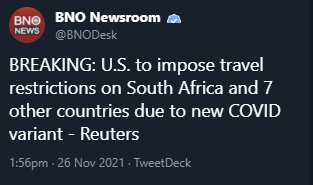
The last day has seen the imposition of new travel restrictions and spreading alarm about the Omicron variant. It sure looks like a repeat of what happened with Alpha and Delta, as well as the original strain back in early 2020, and that we are probably doing this again.
How will this play out this time? It’s very early. There’s tons of unknowns. Yet there is a lot we can say already, and many actions need to happen now to have any hope of doing much good. So it’s time to move fast, see what we can say right now and try to capture the speed premium.
I’ll start with a summary of what we know about the game board based on previous experience, then look at what we know about Omicron and what moves have been played so far in this round.
I was almost finished with this post when the WHO decided to go with Omicron instead of Nu (or even Xi) and then I had to go through and replace Nu with Omicron about 25 times. We could have just said ‘the Nu variant’ a lot but the WHO hates both efficiency and fun even more than it hates freedom, it seems. Sad.
The First Three Times
In early 2020, we got warnings about a new potential pandemic. Almost all reactions were too little too late. What warnings I offered were less too late than most, but still too tentative and too late.
About a year ago, as the Alpha variant was spreading, it seemed like the same pattern was happening again. It was clear Alpha would take over. I extrapolated into the future, did the math as best I could, wrote the post We’re F***ed, It’s Over, noted the unknowns, and predicted a 70% chance of a large wave between March and May.
As I noted in the later update, it was not over. There was no big wave between March and May of 2021. Alpha wasn’t as additionally infectious as I expected, but it wasn’t that much less additionally infectious than I expected, and I didn’t have enough respect for several factors including seasonality. In hindsight the 70% prediction was somewhat overconfident, and a prediction of about 45% would have been better.
Then, as it looked like things would have otherwise died down and normal life resumed, Delta arrived. It was quickly clear it would not be contained for long and Delta would take over. The situation in India seemed super scary, with hospitals overwhelmed and the serious possibility Delta would sweep through the entire population, first in India and then around much of the world.
Then India’s situation stabilized quickly, and it seemed clear we had sufficient vaccinations plus control system reactions to prevent things from getting too far out of hand. There would be a wave now, perhaps another in winter, but it would not be a crisis.
Winter is now coming, and that winter wave is clearly already underway, except now we are likely to also face the Omicron variant.
If Omicron Is What We Think, We Cannot Stop It, Only Slow It Down
Before we get to the details of the Omicron variant, it’s worth taking a step back and asking what we know about such developments in general, and how things are likely to play out and what options might be available.
The first point is the obvious one. There is no stopping a variant that is substantially more infectious than Delta. If Omicron is indeed substantially more infectious than Delta, it will become the dominant strain throughout the world.
Once there are hundreds of detected cases, it is already far too late to successfully contain the new variant. By the time we have enough information to react to a new variant, there will already be hundreds of detected cases. We lose. Good day, sir.
That doesn’t mean there are no physically possible measures that could contain the new variant once there are hundreds of detected cases. It does mean none of them are remotely in the Overton Window, or logistically within the abilities of our governments even if they decided to try anyway. Playing to win the game is not an option here. We lose.
That doesn’t mean we can’t or shouldn’t do things that make us lose slower. We can absolutely slow down the pace at which Omicron displaces Delta.
Whether or not that time is useful depends on what we do with that time.
Perhaps not very much time. The worse Omicron is, the more rapidly it will take over and the less time we can buy with countermeasures. In practice, in terms of the takeover rather than the overall number of infections, we could likely buy ourselves a week or two, but it’s hard to see us buying more than that. We could also institute general restrictions against Covid-19 to reduce the number of infections across the board. Once again, we buy ourselves a small amount of time.
If buying time before a sufficiently large wave gets us better access to Paxlovid or other treatments, or allows us to get a lot more people booster shots that still work, or time to make a new version of the vaccine and roll it out, time can be quite valuable.
There’s also the possibility of stalling to get better seasonality effects when crunch time happens. The wave maxing out in December seems like maximally bad timing, and we’d prefer to push it to January or February.
If you buy time and then it is wasted, then nothing is gained. If you pay a big price to buy time, it needs to be paired with a similarly big effort to make use of that time.
Travel Restrictions
The first step is always a debate over travel restrictions. Travel restrictions feel like Doing Something, and failure to impose such restrictions opens the door for blame.
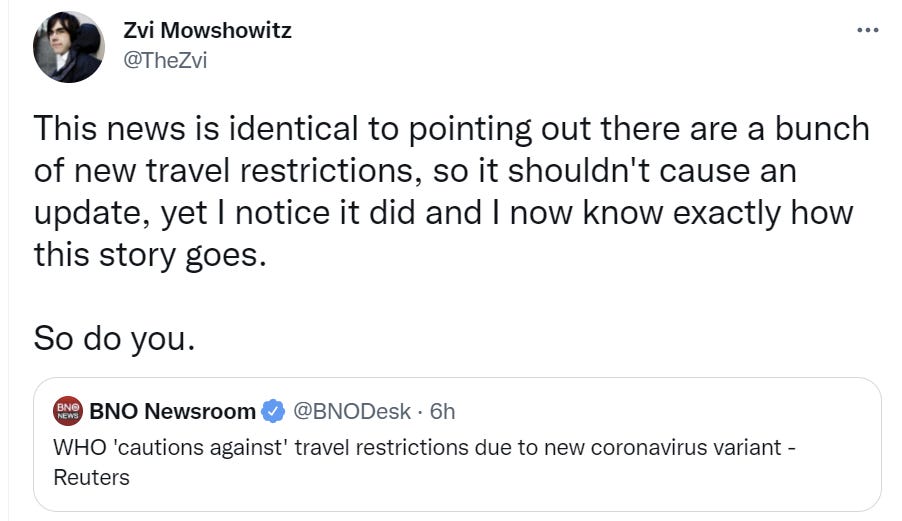
When the WHO warned against travel restrictions, that’s when I knew in my gut what we were dealing with.
Travel restrictions are an excellent idea when the goal is to buy time. They can definitely slow down the rate at which the new variant spreads across borders.
What they can’t do is stop it entirely, even if they are imposed early enough, unless you’re sufficiently serious.
Sufficiently serious means actually closing off or at least aggressively quarantining everyone who has any exposure to the areas in question, which includes any areas not taking similar measures, anywhere. There can’t be exceptions, including for your citizens.
Realistically, your minimum case that could possibly fully work is to be Australia, and quarantine everyone at the border even if there’s no reason to suspect anything, and you need to do it right. That’s not going to happen.
Even if you did succeed, what then? How long are you going to keep your borders closed? A restriction to a few countries might help the first week, but within a month it won’t even much matter, because there’s too much spread elsewhere. It’s not like a variant worse than Delta is going to go away any time soon, so you’re stuck in a permanent state that in most places both can’t be created and can’t be sustained if you did create it.
For those places that showed they can sustain it, would you even want to, and for how long? When would it end? What’s your plan?
The other issue with travel restrictions is they continue long, long past the time when they still make any sense. Once containment has generally been lost, the restrictions don’t do anything. At a minimum, they do nothing unless you’re in a much much better place than the region you’re cutting off, whereas there were many cases of longstanding mutual restrictions where the same variant was dominant in both places, which is pure folly.
It does seem like ‘impose travel restrictions aggressively to buy time’ is a good response. The short term cost is very low, and with so many unknowns the upsides are very high. If you do that, you need to do it very quickly. The best time is a week ago, the second best time is right now, and all that. In the scenarios where it matters most, a week from now there won’t be much point.
Exactly what restrictions are imposed by who, and when, provides strong insight into how various governments respond to new information.
Lockdowns
It’s worth noting that if a new variant is about to displace the old one, then lockdowns designed to stop the spread of the old variant are much less worthwhile. Once there’s a displacement event, the previous infection level no longer matters at all. If anything, previous infections could be an advantage, if the new variant is more dangerous, and/or it means the spread can be slowed down due to natural immunity. The flip side is if somehow natural immunity was going to stop working entirely against the new variant, then every case prevented in the meantime is a pure extra case, which based on history seems unlikely but is possible.
The bigger reason to reconsider existing lockdowns is that there are increasing marginal costs for lockdowns, and a limited capacity to impose them. The early efforts to stop the spread ‘used up’ a lot of that capacity. Lockdowns now, before the crunch time, could end up having little effect and also making it impossible or more expensive to lockdown again later when it matters most. To the extent that lockdowns are a good idea, they need to be timed carefully.
The counterargument to that is that a lockdown suppresses overall transmission levels of the new variant as well. Even if you have only 10 cases, if you slow down spread from those 10, that’s worth a lot and buys you time. That’s true, but mostly only works if you’re no longer importing meaningful numbers of cases from elsewhere, and for various dynamic reasons the amount of time you buy here won’t be very large.
You can also attempt to do a lot of sequencing, then do aggressive quarantines and contact tracing when you find the new variant, but the capacity to do this enough to matter is not present.
Vaccinations
The best defense against prior waves and variants has been vaccination. Every time a new variant arrives, fears are stroked that the vaccines will stop working, or will be less effective.
Despite that, we’ve had months in which we could easily have updated the mRNA vaccines to fully match the Delta variant, we are now giving out booster shots even, and still no sign of any attempt to modify the vaccines.
I’m unsure how much evidence this is against the need to update the vaccines. If the vaccines had stopped working entirely, or taken a sufficiently strong hit, presumably we would have updated to a new version. The FDA has promised to look kindly upon such changes, and it seems like it could only help on both health and financial considerations. My guess is it’s actually quite a bit of evidence against any strong potential gains from updating, but weak evidence against weak gains.
So far, all talk of immune escape has mostly been exactly that, talk. That should make us wary of expecting it out of a new variant, or of updating too much from people’s concerns.
If a new variant comes along that does offer substantial escape from the vaccines, we will need to update the vaccines and get new versions out as quickly as possible. Will we be able to do that?
Technologically I have no worries. We’ll have that part solved within the week and probably within one day.
Engineering I’m also not worried about. My understanding is this is at most a two week process. There are still concerns about rate of production, since we were stupid enough not to scale this up enough in advance, but we’ll take whatever we can get.
It therefore comes down to the FDA making good on its word to allow this to happen, and then on our ability to distribute the new boosters and communicate effectively why they are necessary and get people to accept them. In the short term, we don’t need to worry that much about communication, so that has more time to get its act together.
The other worry is that if Omicron is sufficiently worse than Delta, especially if it combines being otherwise worse with immune escape, the amount of time available might be quite short. Even if everything went smoothly the full process would still take months. We could go faster in theory, but that would require efforts on a different level than we made the first time or have accomplished in a long while on anything. I’m not optimistic.
Biological Priors
When we see a new variant spreading rapidly, what should our priors be about its biological properties?
Note that these are all things we should think are likely rather than anything that we know.
We have explored various potential mutations a lot by now, so we should put a lot of weight on what those mutations imply about the variant’s likely behavior.
We should presume that if something takes over quickly, it has a very large advantage infecting people who are unvaccinated and lack natural immunity.
We should presume that if it also has an additional property of vaccine escape, that seems like quite a coincidence, so it seems unlikely.
We should consider this even more unlikely if the variant started out in places with low vaccination rates.
We should also presume immune escape from either natural infection or vaccination is unlikely from our track record of Alpha and Delta not having this property.
We should presume there will still be more ‘breakthrough’ infections but that this comes from the protection levels no longer being sufficient because the new variant is easier to catch in general, not because the particular protections you have stopped working.
We should presume at this point some positive correlation between infectiousness and virulence, since both are likely tied to how much virus is typical (viral load), and previous variants followed this correlation.
We should be more confident in these things if our tests still work than if they start to fail.
What Do We Know About Omicron?
There have been a bunch of threads attempting to answer this question.
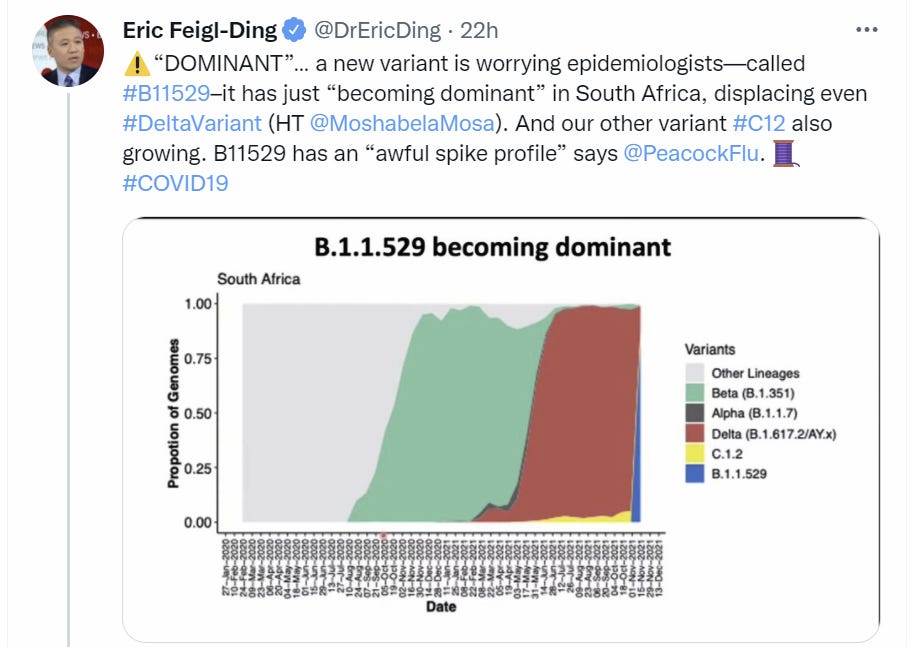
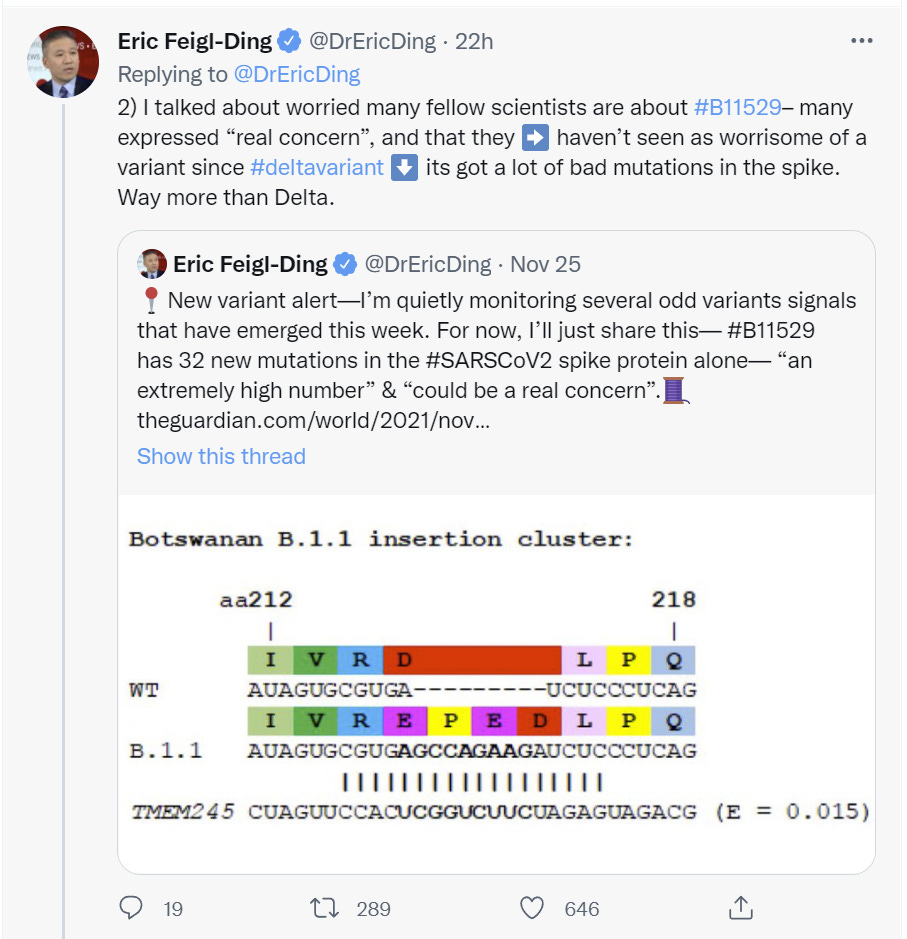
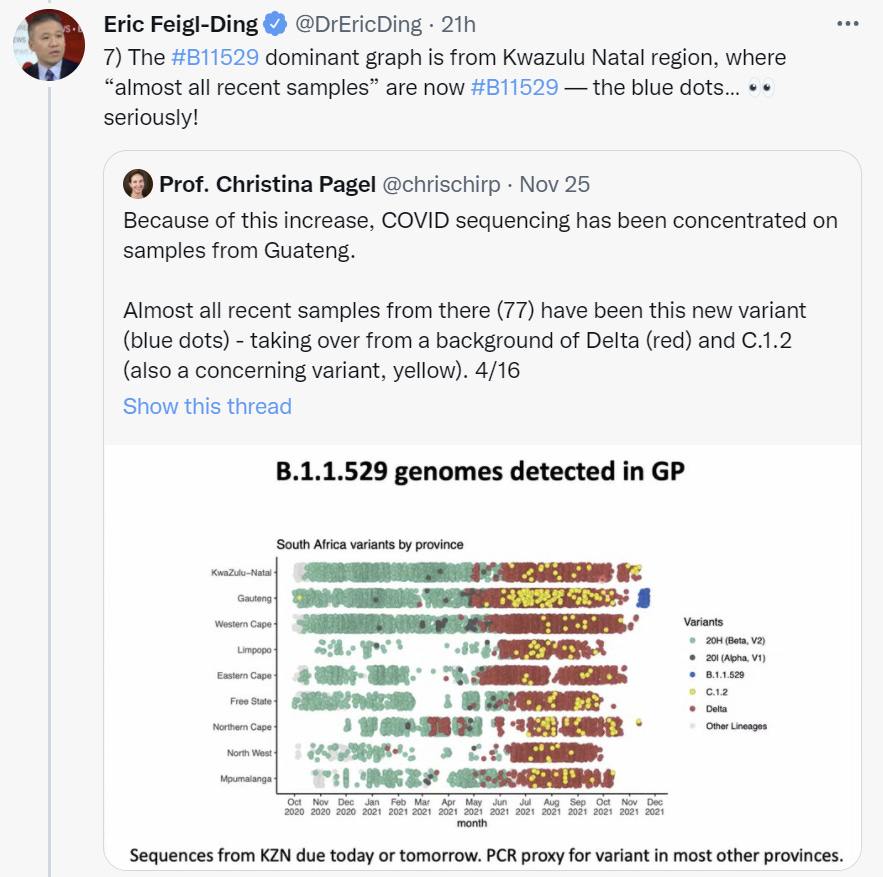
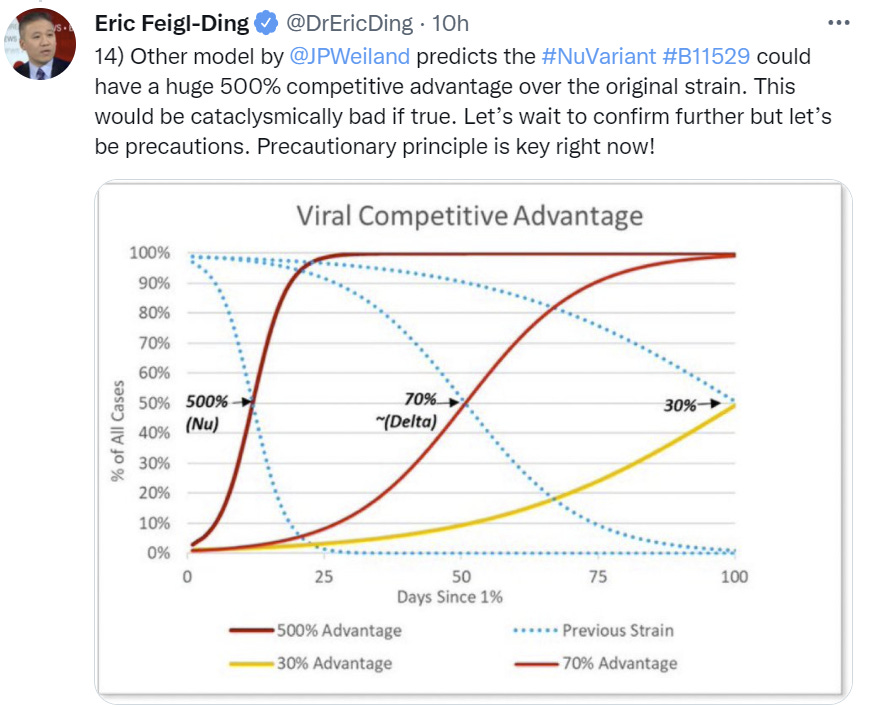
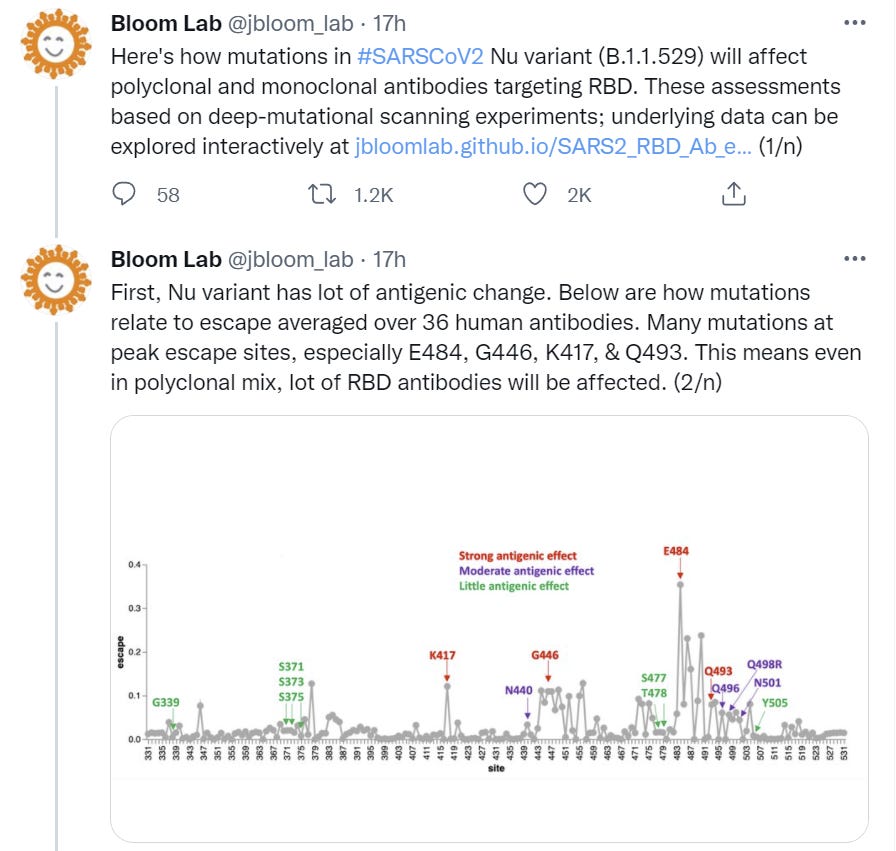
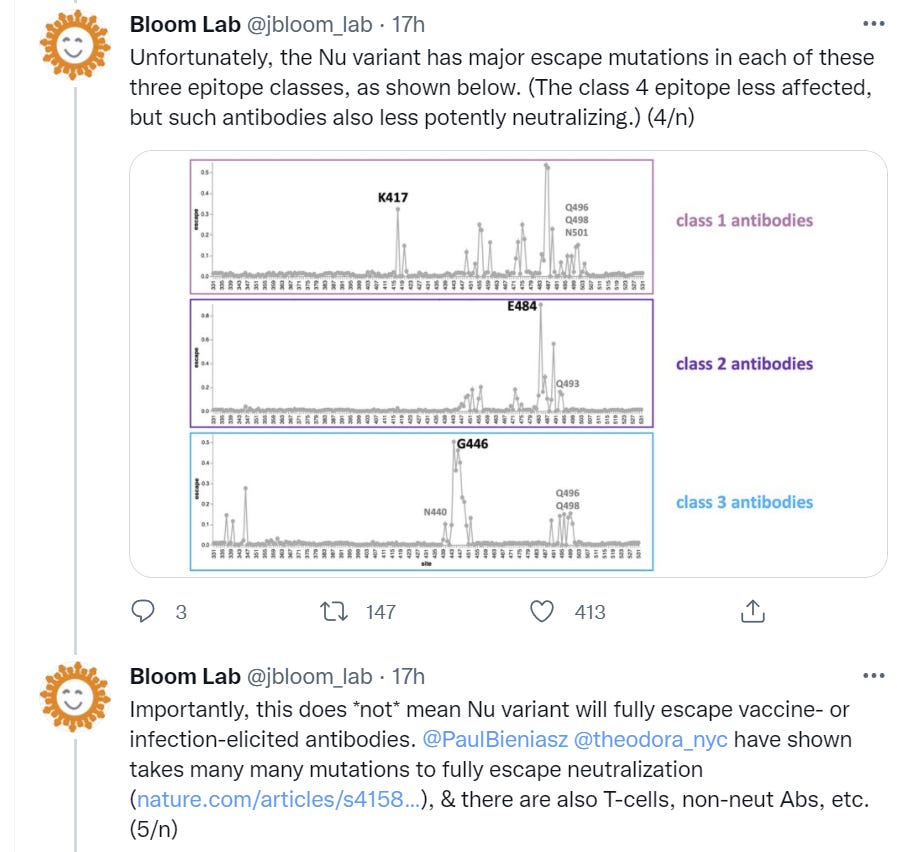
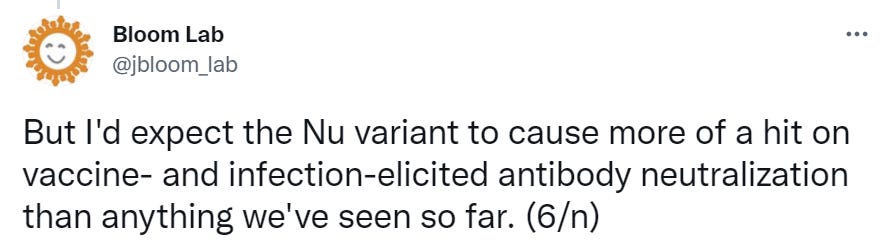
Here’s Eric Feigl-Ding, from Thursday around noon (things are moving rapidly, so timestamps are important).
I’m going to err on the side of directly putting in too much of these threads rather than too little, in the interest of speed, and to offer an easy option to get closer to the sources.
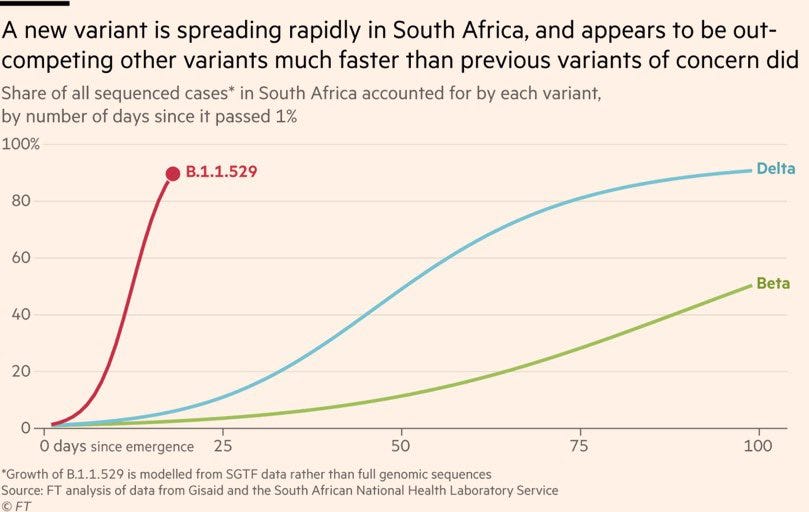
I think this final graph is a bit confused here, unless ‘the original strain’ here means Delta. Delta had about a 120% advantage over ‘the original strain’ or 70% over Alpha. I’m going to take this to mean 500% as compared to that 120%, so 600% of original versus 220% of original, or about a 170% additional increase. Which is… better, but still quite a lot.
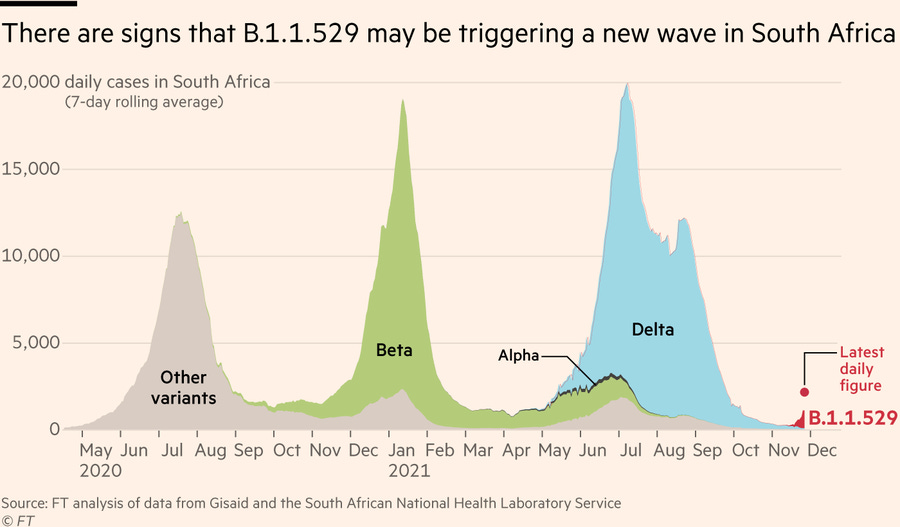
The graph above it does seem to imply that the Omicron advantage over Delta is being modeled here to be several times larger than the Delta advantage over Alpha/Beta, where ‘modeled here’ means looking at share of all cases in the country over time. This is a super scary graph, assuming it is accurate.
There’s also always the question of how this interacts with immune escape. Again, I’m using a baseline assumption that this is the same factor across the board regardless of level of immunity, and there isn’t an additional effect from escape of some kind.
South Africa’s vaccination rate is sufficiently low, and this rate of spread so high, that it wouldn’t much matter if there was vaccine escape properties, although it would presumably matter if there was escape from natural immunity.
Straight talk: If it’s 500% above Delta, in the way I understand it, We’re F***ed and it really really is over. At that point, it’s pure mitigation, and trying to flatten the curve a little bit, but yes everyone who isn’t immune is going to get this, and it would happen quickly. Under conditions where Delta would have had stable case counts, assuming a four day serial interval, this runs its course in America starting from a single case in about 50 days. If we assume 5 days per cycle, we get two months. Probably get somewhat more than that due to geographical barriers. There’d be a lot of attempted heroic prevention in the second half of that (the overall case number impact gets noticeable around the halfway point) and in particular in the endgame but in practice I doubt it much matters.
If it’s 170% above Delta, it changes how much time we have, and opens the door to meaningful action being possible to make things less awful. In particular, it gives a real shot to Paxlovid to be able to scale up in time to matter.
As always, such numbers are placeholders, approximations that simplify and mislead. Things aren’t that simple.
This is the Trevor Bradford thread. He concludes that selection from vaccinations did not drive variants in 2021, but that conditions are changing and such selection grows more likely over time.
This is an argument that the advantage that Omicron has comes largely from its escape properties – it has tons of escape properties, and South Africans can have lots of natural immunity even if they don’t have a high vaccination rate, which is leading to the rapid spread.
Note that while I don’t put zero stock in differential impact on natural immunity versus immunity from vaccination, I don’t put much probability mass there either. I’d presume until proven otherwise that they both will weaken about as much as the other.
I’d also presume that since vaccination without boosters is mostly sufficient to protect against severe disease, and boosters provide a gigantic boost to protection on top of that, and this is not going to fully escape, that a booster should still be sufficient to offer practical protection against the variant, and non-boosted vaccination should still provide strong protection although potentially not as robust as before.
Note that this being about escape is in some ways good news. If it’s about escape, then we don’t have any reason to presume that the new variant is deadlier, or presents something we can’t defend against by renewing our defenses.
I also don’t see any reason to think that any of this would make Paxlovid or other non-antibody treatments less effective, so we’ll still have all of that in our arsenal.
Then again, Bloom Lab points out that there’s a contrasting viewpoint, and some chance it’s worse than all that, although I’d still consider it highly unlikely:
This thread calls for help for South Africa to ‘help contain’ the virus, and to avoid ‘isolating’ the country. I don’t see how one could hope to contain anything at this point, regardless of help, or how not isolating could make sense. The call to provide other kinds of help seems right.
Link above is to the 7th post in the Bloom thread above, below to the 2nd one.
This seems like the reasonable skeptical take. Things could be quite bad on any number of fronts, but we don’t know much yet. I agree that any pronouncements on severity should be treated with even more extreme skepticism.
Putting it all together, it seems likely that at least some of the advantage here comes from escape, or what Kai prefers to call immune erosion, but that we can be confident that this will only be partial.
We can’t be sure how much additional transmission advantage Omicron will have on top of that, but the Hong Kong case is suggestive given there are so few other cases abroad, and this level of rapid spread seems unlikely to happen only (or even primarily) from immune erosion properties. In the scenarios where the growth rate is ‘real’ in the sense that it reflects a very high transmissibility advantage for Omicron, I’d be very surprised if it wasn’t better at spreading among the unvaccinated never-infected.
That’s not a very large red area on the right, but it is a very rapid rise. Still a chance this is all a blip. We will know more very soon.
The overall levels are still small, compared to places like the United States:
You might think this is lack of testing, but no, it’s not.
This is the biggest reason to think this could all still be a false alarm. A large rise from a very small number means a lot less.
Despite this, of course, it’s still too late to contain the situation, which is why I’m saying that we will basically never contain such situations. A few thousand cases is too many to come back from, and we’re already seeing cases in many other places – one in Belgium, one in Hong Kong and one in Israel.
World Reaction
The financial markets are taking this seriously. You can never be sure about such things, but from what I’ve seen the details of what is moving in what direction sure look like this is the ‘Covid beta’ rather than something else.
The large decline in Crypto is especially interesting, because we saw a similar thing in 2020 that at the time clearly didn’t reflect long term prospects and was based on the flows that happen in such situations. At the time I was too distracted to pull the trigger, which is quite sad. If the current move gets much bigger, then to the extent that one wants to be long, it seems like a potential opportunity to buy cheap (Not Investment Advice!).
That market reaction was motivating to get me to look at this quickly and take it seriously, and is definitely influencing my probability of this being ‘for real’ quite a bit.
The other big response was, of course, travel bans. The WHO warning against them is what got me to snap to attention and write this quickly, which also tells you what I think of the WHO:
I have a lot of news sources, but for pure ‘just the basic things that are happening around the world regarding Covid’ my source of choice is the BNO Newsroom and in particular their twitter feed. Here’s some stuff that happened, in chronological order, after a lot of different news items about various new European case counts and restrictions over the previous few days.
As far as I can tell the WHO’s reaction was to attempt to stop nations from closing borders.
An accompanying press release did a standard call for preventative measures, which doesn’t seem connected to any model of how that would help.
The UK goes first and fast, cutting off travel from six countries rather than only South Africa, as one would do if taking this seriously. Of course, if taking this fully seriously you’d cut off everyone, but that’s a much bigger ask, especially at this early stage. Again, we never actually win at this, we only lose slower.
The note of a ‘threat to the vaccine programme’ looks to me like an important insight into the psychology here. The entire pandemic is seen through the eyes of the vaccinations, and as a fight to be won, rather than as a more broad situation in which vaccines are the strongest tool but the goal is to do the best we can in practice.
So we see the jump, as always, to ‘maybe the vaccines will stop working.’
Israel second. The UK did first doses first and otherwise took its own path to vaccine distribution, some would say even exiting the EU for related reasons. Israel did what it had to do to get more vaccine doses faster, and give them out quickly.
Those two being the first two to ban travel does not seem remotely like a coincidence.
The timeline says this jump came after the UK and Israel took action, which is impressive. The extra day’s data makes a big difference.
Direct link to the tracker here. Doesn’t appear to let you view things over time, so here’s the snapshot now, as I’m writing this, at 12:52pm on 11/26, during which time South Africa’s case count hasn’t been updated:
Singapore up next, and again, does this seem like a coincidence to you at all?
Israel and Hong Kong (and later Belgium) detected the first cases not in Southern Africa, while also seeming like the places that would notice such cases first. Let’s not pretend it hasn’t arrived here yet.
Note the contrast. The EU proposes a ban and will consider it. The UK went ahead and did it.
Not that every EU member was about to sit around and wait.
Germany noting the ‘variant of concern’ and then saying they’re ‘very worried’ while not stopping flights is an interesting news item there, while others drop the hammer. Short Germany?
As long as you don’t, ya know, actually do anything about it, as we’ll see in a second.
Oh well, nothing we can do about things like that.
Very glad to see that they did quarantine the entire flight.
We are still going to ‘wait for more information.’ Others do not have that luxury.
Less than a day still isn’t so bad – they did it while I was writing this. Kudos.
Seriously, WHO, could you people be any less helpful? We all agreed on Nu and now we have to type Omicron all the time? Couldn’t even use Xi?
Here’s their announcement.
So please gather information and encourage everyone to take all the same measures as before, and otherwise do nothing.
A quick scan of the new Belgian report does not seem to indicate information I didn’t already have from Twitter. Here are its recommendations:
7. Recommendations
The identification of a first B.1.1.529 positive case in Belgium (but also at the European level) highlights the rapid international spread of this variant. Risk mitigation strategies should include travel restrictions or reinforced screening procedures at the international level (not only travels linked to South Africa), accelerating vaccination campaigns worldwide and accelerating the delivery of booster doses for the most fragile populations, reinforcing disease control interventions at all levels. Further, offering maximal support to African countries to ensure reinforced disease surveillance and control remains a high priority. These standard recommendations should shortly be updated based on the evolution of our understanding of the impact of this variant with regard to virulence, infectiousness, vaccine efficacy and activity of existing antivirals.
That all seems highly sensible, if incomplete.
EDIT: The actual moment I hit the send button, we did in fact restrict travel:
Current Model
In the interest of the speed premium, I’m going to summarize my current thinking, while noting that I haven’t had that much time to think it over (nor has anyone else), and that my opinions will doubtless change quickly as the situation develops and also I have time to think.
Also, having to do this gives me a chance to do some intuition pumping.
These numbers are best guesses right now but please don’t take them too seriously or stick to them as the situation changes. If I don’t look stupid with some of these, then that would be me twisting my numbers to not look stupid. These numbers probably don’t live in the same universe and you could probably make very good bets against me by figuring out where they’re inconsistent, were I willing to book them, but these numbers aren’t supposed to be robust enough for that.
Anyway, here goes.
Chance that Omicron has a 100% or bigger transmission advantage in practice versus Delta: 30%.
The estimates in the threads were very large, including numbers like 170% and 500%, but I notice that my median estimate is far lower. That’s because the overall numbers are still small, and variants have a way of starting out spreading super rapidly for various reasons well in excess of how much better they end up spreading at equilibrium. This could all still be very overblown, and especially that’s likely in terms of the huge estimates of transmissibility advantage.
Chance that Omicron will displace Delta: 70%.
This implies there’s about a 40% chance that Omicron will displace Delta but with a <100% advantage, which seems at least reasonable.
In terms of this being a favorite at this point, I agree it’s still early, but also the pattern matching is way, way too good, and there weren’t any false alarms that got to this level of concern.
Chance that Omicron is importantly more virulent than Delta: 25%.
I mean everyone knows they don’t know, and this is definitely me guessing in a largely unprincipled way at this point. The virtue of putting a number on it even when you have no idea.
Chance that Omicron is importantly immune erosive, reducing effectiveness of vaccines and natural immunity: 50%.
There’s a lot of baseline biological reasons to suggest this, and there’s a lot of trust that this translates into actual effects, but will the effect be ‘important’? That’s harder to say, and we have skepticism from previous rounds. Seems likely that protection against infection will decline.
Chance that Omicron means the vaccinated and previously infected are no longer effectively protected against severe disease until they get an Omicron-targeted booster shot: 5%.
I find this much less likely than a waning of immunity to infection and modest decline in severe disease protection. Our immune systems are robust, the protection against severe disease from vaccines and infections has held up even when breakthroughs happen or vaccine effectiveness declines over time. 5% is a lot more worried than I was yesterday! And if that does happen, things are going to go very haywire, but for now I’m only at 5%.
Chance we will be getting boosters modified for Omicron within 6 months of our previous booster shot: 15%.
I notice that I don’t expect this to happen in many of the worlds where it would be an obviously necessary idea.
Chance that Omicron is less vulnerable to non-antibody treatments like Paxlovid or Fluvoxamine: 5%.
This is an ‘unprincipled’ 5% based on weird stuff happening, and I could probably get a lot more confident in a hurry by asking experts quick questions, but as far as I can tell there’s no interaction between such treatments and the changes in Omicron. So I can’t rule it out, but I find this unlikely.
Chance we are broadly looking at a future crisis situation with widely overwhelmed American hospitals, new large American lockdowns and things like that: 20%.
My gut is something like: Even with a huge transmission advantage, we might not get to this point because of vaccinations and Paxlovid, if we have enough time for that, and because every wave ends up peaking on its own one way or another, and there’s a ton of immunity already even if it will be weakened somewhat. If we assume 100% transmission advantage, there should be enough time to get Paxlovid online, so I think this is less likely than the doubled transmission, but I do notice that it’s on the table. Again, I expect to move this number quickly if I were to think more about it.
Final Thoughts
This has been written super quickly, so it will have mistakes, especially mistakes of reasoning. That’s how it works in a rapidly developing situation. Here’s the practical view for now.
If you haven’t had a booster, I’d consider getting one. Waiting for modifications for Omicron seems wrong, as if that happens demand will exceed supply for too long. If Omicron is for real, it might become very difficult to get an appointment for a while.
If you have things to do that involve exposure, all the more reason to do them now rather than wait. If you have travel plans a while out, don’t get too attached.
If you don’t have emergency supplies in case of another lockdown, maybe start thinking about what you’d need and stock up early on things that will keep or would be super important. Even if it’s unlikely, you want to notice when it becomes likely.
The chances of things ever fully ‘returning to normal’ went down once again, except if we decide to return to normal and live our lives anyway. We need a plan to do that, now more than ever.
From 1865 to 1909, Belgium was ruled by a great king. He helped promote the adoption of universal male suffrage and proportional-representation voting. During his rule Belgium rapidly industrialized and had immense economic growth. He gave workers the right to strike. He passed laws protecting women and children. Employment of children under 12, of children under 16 at night, and of women under 21 underground, was forbidden. Workers also gained compensation rights for workplace accidents and got Sundays off. He improved education, built railways and more.
Around the same time, Congo was ruled by an awful dictator. He ruled the country using a mercenary military force, which he used for his own gain. He extracted a fortune out of ivory. He used forced labor to harvest and process rubber. Atrocities such as murder and torture were common. The feet and hands of men, women and children were severed when the quota of rubber was not met. Millions have died during his rule.
The catch? They were the same person - King Leopold II of Belgium. He's part of a small club of people that have led more than one country, and might be the only one who did so simultaneously. What made the same person act as a great king in one nation and a terrible dictator in the other? If neither innate benevolence nor malevolence led to his behavior, it has to be something else.
Leopold II, 1900
This post covers Selectorate Theory. We'll come back to the story of Leopold and see how this theory explains it, but first, we have to understand the theory.
The theory takes a game theoretical approach to political behavior, by which I mean two things. First, that it's built on a mathematical model. And second, that it's agent and strategy based. That means the analysis doesn't happen at the level of countries, which aren't agents, but at the level of individuals, like leaders and voters, and that the behavior of these agents is strategic, and not a product of psychology, personality or ideology.
This abstraction makes this model more generally applicable beyond countries to any hierarchical power structure, such as small local governments, companies, and even small teams and groups, but to keep things simple I'll only talk about it in the context of countries.
I will try to give a comprehensive overview of the theory based on the book The Logic of Political Survival. We'll start with the basic framework, then go through the predictions and implications the authors talk about, then I'll mention further implications I think the theory has.
I won't go over the statistical evidence for the theory, except for a brief comment at the end, or over the mathematical model itself[1] - the post is long enough without it - but I might do that in future posts.
I want to thank Bruce, the first author, for reading this article before publication. I sent him a question, not even sure I would get a response, and mentioned the article, saying I'd be happy to send it to him. He responded in just two hours and agreed.
Also thanks to Shimon Ravid, Nir Aloni, and Daniel Segal for beta reading this article.
The Basic Framework
The theory is based on the idea that the primary goal of leaders is to remain in power, or put simply, to survive, and that the behavior of organizations can be predicted through the optimal survival strategy for the leader, which depends on various properties of that organization.
To do all that, we need to make some assumptions and build a simple model of a country and the people and groups in it. The theory doesn't use abstract terms like "democracy" and "dictatorship" to define nations, instead, it tries to derive them from other properties.
The Groups
Every country has a leader, and usually also a challenger for leadership. The other residents of the country are split into three groups, the Winning Coalition, which is part of the Selectorate. Those not in the selectorate are the Disenfranchised.
The Leader
The leader or leadership is the one who can make policy decisions - this means Tax policy, and spending policy, which is the allocation of tax revenue to public goods and private goods.
These two assumptions about the leader are the basis for the whole theory:
No ruler rules alone. Every leader has to satisfy at least some people in order to rule. If they don't satisfy them, they'll be deposed.
The leader's goal is to gain as much influence/power/money as they can, and to keep it for as long as they can. This may sound cynical. And it might be, somewhat. But it also makes sense. Holding office is required to achieve the leader's personal goals - whether these goals are selfish or altruistic. To some people holding office isn't that important, but these people don't usually become leaders, and if they do, they don't stay long.
The leader's desire to survive stays constant, but the most effective survival strategy changes depending on the size of the other groups and other facts about the nation.
Residents
All residents engage in economic activity, pay taxes, and benefit from public goods. The size of the population determines the cost of providing public goods and increases how much tax can be collected. Residents may be included or excluded from the selectorate. Those excluded are called the disenfranchised.
The Winning Coalition
The Winning Coalition are the essentials, the keys to power - The people the leader has to satisfy to survive. The leader does that by rewarding them with private goods. The size of the Coalition (w) is one of two most important characteristics of a nation.
When the coalition is small, the leader can give private rewards to each person in the coalition. The more the coalition grows, the more expensive it becomes to produce private rewards for all coalition members, so the leader starts producing public goods instead.
This creates an interesting dynamic. When the coalition is sufficiently small, making it smaller is within a coalition member's interest (as long as they aren't the ones getting ejected, of course) since it lets them demand higher pay from the leader. As the coalition gets larger, there comes a point where it's better for the coalition to expand, as all of them already get so little private goods, that they can all benefit more from the leader creating more public goods and less private goods.
We'll see how small winning coalitions create autocracies and monarchies, and large coalitions create democracies.
The Selectorate
The Selectorate are those who can influence who gets to be the leader (say, by voting). The size of the Selectorate (s) is the other most important characteristic of a nation. They do not get private rewards from the leader, but still benefit from public goods. The base rate probability of being included in the coalition for any selectorate member is w/s.
The selectorate wants the winning coalition to expand, since then more money will be spent on public goods, and it increases their own chance of getting into the coalition. They don't want the selectorate to expand as that decreases their chance of inclusion in the coalition - though this effect gets weaker as the coalition grows and more public goods are produced.
In the real world, common characteristics societies use to divide people in and out of the selectorate include birthplace, lineage, skills, beliefs, knowledge, wealth, sex and age. In the Coups and Revolutions section, we'll see how military ability matters especially.
The disenfranchised
The disenfranchised are those who don't have any influence over who gets to be leader. They too do not get private goods, but still benefit from public goods. The disenfranchised want the coalition to expand for the same reason as the selectorate. They also want the selectorate to expand so they may be included, but have no established way of making that happen - other than violence and asking nicely.
The Challenger
The Challenger is a person that challenges the current leadership in order to replace it. The challenger has a commitment problem - they have to get support from at least some members of the current coalition to win, but even if they promise to those who defect to their side that they will get more rewards than they currently do, they can't guarantee that, or even guarantee that they'll remain in the winning coalition at all.
The challenger can be anyone, but challengers from within the current coalition have an inherent advantage - they automatically get and take one supporter away from the current incumbent.
The challenger usually has a similar interest to the current incumbent (except who's the leader, of course) since they wish to replace and get the same benefits as the leader, or more. For example, if the winning coalition grows, the country the challenger is trying to take over now has a larger coalition, which makes it less valuable.
Economy
Every game theory model has to state what agents desire and get value from, and every model of a country needs to model some basic economics.
In this model the things people value are:
The untaxed portion of their economic activity
Leisure
Public goods
Private goods (only available for coalition members)
And the leader values:
Above all else - staying in office. If the leader fails to stay in office nothing else matters.
And, if they remain, tax revenue not spent on public or private goods.
Residents split their time between economically productive activities, which we'll shorten to work, and economically unproductive activities, which we'll shorten to leisure.
More specifically, work refers to activities that can, and leisure to activities that can't, be subjected to:
Taxes
The leader decides on the tax rate,and collects the revenue.
The theory defines the tax rate as the percentage of total economic products the government extracts from the residents. No complex tax policies here - any such policy is simplified to that definition for analysis. But as we'll see, the theory does make predictions about more complex tax policies.
When the tax rate is 0%, residents split their time equally between work and leisure. As the tax rate increases they work less, until at 100% they spend all their time on leisure.
As people work more their income increases, which further increases the money available for taxation. Together this creates a tension between tax rates and GDP (the sum of what is produced by the economic activity of residents).
High tax rate > Less productive economic activity > Lower GDP overall
Low tax rate > More productive economic activity > Higher GDP overall
The tax revenue is a percentage of the GDP, so the leader always wants to find the tax rate that will create the most revenue.
Spending
The leader splits their tax revenue between private goods and public goods. Whatever isn't spent on those is the surplus, with which the leader can do whatever they want - engage in kleptocracy and keep it to themselves, invest it in some pet project, or keep it as a cushion against future political rivals.
Goods are assumed to be "normal", such that more is always better.
The optimal spending strategy for the leader requires finding how much needs to be spent on the coalition in total, and how much of that should be split between private and public goods.
Private goods only benefit coalition members. The pool of private goods is divided between the members of the coalition, making the value of private goods shrink as the coalition size increases.
Public goods are indivisible and non-excludable - they benefit everyone and have to be provided to everyone. Think roads, defense, education, sewage, the grid and communications. The price of public goods rises with the size of the population.
It's not necessary that any one good will be a pure private or public good - the theory simply deals with how much is spent on each type. Almost any public good will also have private benefits. If in the real world one of the things I listed as a public good is excluded or divided, it just becomes partially private.
Loyalty and Replaceability
The loyalty norm refers to how loyal to the leader are the coalition members . It is defined as the size of the winning coalition divided by the size of the selectorate (w/s) and it is also the base rate probability that a selectorate member will be part of a winning coalition.
A strong loyalty norm happens when coalition members are easy for the leader/challenger to replace. A weak loyalty norm happens when it's hard. The larger the selectorate is compared to the coalition, the more replacement options there are, which makes it easier to replace coalition members.
Selectorate size close to coalition size > Large w/s ratio (closer to 1) > Hard to replace members > Weak loyalty norm.
Selectorate size much larger than coalition size > Small w/s ratio (closer to 0) > Easy to replace members > Strong loyalty norm.
The three rough clusters of political systems (the leader's preferences go from left to right)
A weak loyalty norm means members of the coalition are more likely to defect to the challenger (since the probability of being included in the coalition is higher), and will require more spending from the leader to stay loyal. A strong loyalty norm means low chances of defection, and less required spending. Needless to say - Leaders like strong loyalty from their supporters.
This creates two competing effects on the coalition's welfare. On one hand, expanding the coalition reduces the amount of private rewards each member gets, on the other hand, if the selectorate size is kept constant, it increases the total amount spent on the coalition.
The following graph shows the relationship between the size of the coalition and these two effects.
The Logic of Political Survival, figure 3.2, reproduced
Whether the coalition prefers to shrink or expand depends on where they are on this graph.
Coalition members prefer weak loyalty. When they're on the left side of the graph they only want to do so by shrinking the selectorate, since expanding the coalition would hurt their welfare, but on the right side of the graph both options are good for them.
Shrinking the coalition without shrinking the selectorate will increase loyalty, but if the coalition is small enough the extra goods compensate for it.
Affinity
Affinity represents the idea that there's some bond between leaders and followers independent of policy that can be used to anticipate each other's future loyalty. All else being equal, people prefer to support leaders they have affinity for, but they won't support a leader with worse policy due to affinity. It is used in the mathematical model only for tie breaking, and isn't necessary for any of the main conclusions of the theory.
Leaders include in the coalition those they have the most affinity for. But, affinity has to be learned, and can never be known perfectly. Affinity is learned by staying in power. Challengers can have some knowledge of affinities before coming into power, but they'll always learn more once they're in power, and will remove and add coalition members as they do.
This asymmetric knowledge of affinity creates the Incumbency Advantage, expanded upon in the next section.
Deposition
The deposition rule defines the circumstance under which an incumbent leader is deposed. In the book they use a deposition rule called constructive vote of no confidence, which simply means a coalition of size w is both sufficient and necessary to stay in office (though not sufficient to get it in the first place). For the challenger to win, they must both have enough supporters that they can create a coalition of size w, and get enough people to defect from the current leader so that they lack w supporters. In other words, if less than w of the incumbent's coalition supports the incumbent and at least w of the challenger's coalition supports the challenger, the incumbent is deposed and replaced by the challenger. Otherwise they stay. Hence the amount of people who's choice actually matters is never greater than 2w.
(The authors say that other deposition rules are plausible, but produce similar results, so they focus only on this one. We'll take them at their word for now and do the same, since we'll need to reproduce the mathematical model to see for ourselves.)
Coalition members who are only in the Incumbent's coalition will always prefer to support the incumbent, likewise for the challenger's coalition. Hence the decision depends on those who are in both coalitions, and on them the challenger has to compete with the incumbent, by offering a better deal.
The incumbent, to stay in office, has to at least match the challenger's offer. So the incumbent's strategy is to maximize the surplus after offering their supporters at least as much as the challenger's best possible offer.
Incumbency Advantage
The incumbent has the advantage, since they have better knowledge of affinities and can promise inclusion in the coalition and private goods more credibly, while the challenger cannot credibly promise to keep supporters in their coalition. The Incumbency Advantage is inversely related to coalition size, as the larger the coalition the less private goods matter.
The more the selectors know the affinity between them and the challenger, the lesser the incumbency advantage, and the more they'll be willing to defect. The incumbent counters that by oversizing their coalition, so they can punish defectors and still retain power.
The risk of defection moves from the risk of not being included in the challenger's coalition, to the risk of being excluded from the incumbent's coalition, or a mix of the two.
With the model in mind, we can see how the interaction of all these interests and incentives imply and predict various political behaviors.
Scope and Limitations
But before I get into the implications and predictions of the theory, I want to lay out the scope of the theory and its limitations.
The model doesn't distinguish between one ruler having all authority to set policy and a large group of legislators all capable of setting policy. For the purposes of the theory, they're treated as an individual and their inner group dynamics aren't addressed. This might sound like a big shortcoming, but I think the theory does exceptionally well even with democracies, considering that it abstracts the decision making process so much. Also unaddressed are questions of separation of powers and checks and balances.
The theory assumes no limitation on the implementation of policy. The theory has implications on how inefficiencies are addressed and how strategies are implemented, as far as they can be described as goods, but not on what the strategies themselves are.
The model treats good very abstractly. It does not deal with the question of which goods are prioritized (beyond public and private).
The model also assumes all members of all groups to be identical (except for affinity). There are no differences in competence. Particular interests (beyond what is covered above in economics) like protecting the environment, advancing science, or buying lots of yachts are not represented. Leaders don't represent people who share their opinions, but those who share their interests (and are in the coalition).
The theory naturally lends itself to being fractal - meaning every group might have subgroups with a similar structure, where the leader of the subgroup is an individual from the super-group. For example, a member of a country's selectorate or winning coalition might be the mayor of a town. With that said, the analysis in the book focuses on one level at a time, and doesn't consider interplay between levels (Though see bloc voting later in the article, which comes close to that).
That said, we should see that the insights from this theory have implications on all these questions when explored on their own.
Implications/Consequences/Predictions
With all those limitations in mind, the authors still extrapolate the implications of the model to a vast array of subjects, giving many concrete predictions. In this section I'll try to give a comprehensive overview of these implications and predictions.
Form of Government
The three general clusters of polities produce the characteristics of various regime types we're familiar with.
Large winning coalition systems resemble democracies - The leader requires a large supporter base, near or totally universal suffrage is common, plenty of public goods are provided and relatively little private goods, taxes are lower and economic productivity is higher.
Small-coalition, small-selectorate systems resemble monarchies and military juntas - The leader requires a small supporter base chosen from a small group such as aristocrats, priests and military persons, little public goods are provided and many private goods, people aren't rich. Examples: Old England monarchy, Saudi Arabia Monarchy, Argentine Junta in 1976-1983
Small-coalition, large-selectorate systems resemble autocracies - The leader requires a small supporter base chosen from a vast pool of potential people who otherwise usually only participate in rigged elections, the amount of public goods is tiny and the amount of private goods big but smaller than in monarchies, the leader extracts the vast majority of people's wealth and people are extremely poor. Examples: The soviet union, North Korea, Maoist China.
Smaller variations in size can account for variations within these regimes. It's hard to say which of two democracies is more democratic, or what makes it so, but if we can estimate the winning coalition of both, it's easy to say which is larger and what we should expect based on that. Not all democracies are the same, and neither are monarchies and autocracies - some more extreme and some milder.
I will sometimes use these regime types instead of specifying coalition and selectorate sizes, but remember what it represents are coalition and selectorate sizes. I do it mostly because it makes for less awkward phrasing, but also to reinforce the connection.
Transitional Democracies
When autocracies transition to democracies and expand the selectorate faster than they expand the coalition, the loyalty norm increases, which mimics the structure of a more autocratic system where the coalition is smaller relative to the selectorate. In such cases transitional democracies will temporarily exhibit more autocratic behavior like kleptocracy and willingness to start wars. This shouldn't happen in transitional democracies that either increase the coalition first, at the same rate, or faster than the selectorate.
Presidential VS Parliamentary Democracy
In presidential systems the leader is usually elected directly by the people. In parliamentary systems the people choose a group of legislators which choose the leader themselves. As we'll see in the next section, this means they require less votes to be elected, leading to a smaller coalition. The US, which has a presidential system but also has indirect elections through the electoral college, is an exception.
Federalism and Localism
The authors predict that corruption will "rise as one moves down the ladder from the central governments to state or provincial governments and on down to city, town, and village governments. Each successive layer relies on a smaller coalition and so provides more incentive to turn to private rewards rather than public goods as the means of maintaining loyalty. That incentive may be partially offset by the central government's incentives to protect the rule of law, one of the central public goods it can be expected to provide."
Federalism should let people benefit from both the benefits of large states and the benefits of small states.
Correlated Support, Bloc Voting and Indirect Election
The basic model assumes selectors are independent - the choice of one selector doesn't influence the choice of another. But of course that's not the case in reality. If we relax this assumption we can see how correlation in selector support effectively reduces coalition size.
The people's choice of support one person can influence, how many people their support correlates with, the more valuable they are as a member of the coalition, and the less the people influenced are. This applies to influential writers, speakers, celebrities, prominent community figures, owners of media outlets and so on.
Bloc voting is when a group votes similarly, usually based on the directives of one person.
In such a case that person becomes highly valuable as a member of the coalition, since their support is effectively equivalent to the size of the group that follows them. The leader would want them in the coalition, but not their followers.
Whether the followers benefit from the bloc leader being in the coalition depends on whether that leader shares their rewards with them, which will depend, like just the leader of the country, on the structure of that group (See note about fractality in Scope).
When leaders can't reward people directly for their support, like in democracies where the vote is anonymous, they may still be able to reward groups. For example in Israel each ballot box is counted independently, and then the results from each ballot box and in each town is made publicly available. You can see the last election results here. This makes it very easy for politicians to invest more in places that support them and ignore those that don't.
Bloc voting can be institutionalized through indirect election, where instead of directly choosing the leader, citizens choose electors who choose the leader for them.
The US has the electoral college. In Israel the prime minister is chosen by the Knesset. In both cases they're not completely free to support whoever they want, the US electors can have limitations set on them by the states, and in Israel Knesset members need to be careful of displeasing their supporters, but in both cases it still reduces the influence of the people on the final outcome.
(The Dictator's Handbook splits the selectorate in two to make this distinction between those who can potentially influence, which they call the "nominal selectorate" or the "Interchangeables", and those who actually choose, which they call the "real selectorate" or the "Influentials". Though this distinction is useful for bloc voting and indirect elections, it's not consequential elsewhere, so I chose not to use it.)
Selectorate theory suggests that leaders have an interest to increase things that cause vote correlation such as ethnic, racial, religious, linguistic and other social divides. Residents benefit instead from increased independence of votes.
Term Limits and the Verge of Deposition
Leaders that expect to be deposed the next time they're challenged have nothing to lose, but much to gain if they can manage onto hold to power. Therefore they'll be more willing to do reckless things to survive, like going for a diversionary war.
A term limit creates two opposing effects.
It reduces the incumbent's advantage, because they can't supply private goods beyond the end of their term. This forces the leader to work harder to please their supporters.
It removes any reselection incentives by decoupling policy performance and survival, making the leaders stop working for the state, and turn kleptocratic.
The second effect comes from having nothing to lose, but since there's also little to gain from reckless actions, the leader is more likely to turn to kleptocracy to make the best of the remaining time than to do something that will keep them in power. Civic minded leaders may use this freedom to take actions that the public would like but the coalition wouldn't.
Post office consequences for kleptocracy can reduce the second effect.
The effect of term limits on spending by incumbents. The Logic of Political Survival, figure 7.3, reproduced and simplified.
Enforcing term limits requires the winning coalition to remove the incumbent. Since in small coalitions the value of inclusion and risk of exclusion are higher, the members don't want to enforce the limit and risk exclusion. This is why autocracies rarely have them, democracies often do, and some autocracies (mainly those with rigged-elections) have fake, unenforced term limits.
Political survival
The theory predicts that leaders in autocracies survive longer in office than in democracies, with monarchies in between.
This stems from the Incumbent's advantage in guaranteeing inclusion in the coalition and promising private goods. So as the coalition expands and public goods become more important, the incumbent's advantage diminishes.
Small coalition > competition is over the provision of private goods > The incumbent has a big advantage
Large coalition > competition is over the best public goods policy > The incumbent has a smaller advantage
In the early period in office the new leader still hasn't learned affinities and sorted out his coalition, and therefore he lacks the incumbency advantage. Competitors will prefer to depose them as quickly as possible to take advantage of that. Therefore the early phases are most dangerous, but if the new leader survives them, they can persist for very long. This affects small-coalition systems more than large ones since their leaders are more dependent on private goods. This creates a higher variability in tenure in small coalition systems than large coalition systems.
Autocracies often have leaders like Stalin and Gaddafi who ruled for 39 and 42 years respectively. But they also more often have leaders like Bachir Gemayel who only survived two weeks in office before being assassinated. In democracies most elected leaders serve their full term, and are voted out after one or several terms if they don't hit a term limit.
Former leaders are dangerous to current leaders, as they're similar to a challenger with very good mutual knowledge of affinities with their supporters. The more important political survival is to the leader, the more incentive new incumbents have to permanently get rid of (say, by killing) the deposed leader. This leads us to expect that deposed incumbents are most likely to be killed or exiled in small coalition systems, and even more so when the selectorate is large. This can be seen as another reason leaders will want to keep power, though that's not included in the model.
Death
When leaders are terminally ill, coalition members know that soon they will stop receiving private goods. This breaks their loyalty and drives them to defect. It might even become a competition of who defects more quickly to the new leader.
This makes small coalition leaders hide their health status from their supporters. This effect diminishes with coalition size as private goods become less important.
One way leaders can mitigate it is by having credible heirs who will take their place but keep the same coalition. Then coalition members have less to worry about not being included in the next coalition, and are happier to stay loyal.
Longtermism
Everything Leaders do they do with the purpose of keeping and gaining power, therefore as long as the coalition doesn't know, any effects their policies have after they leave office are unimportant. Policies that will have a good effect in the future are good only if the coalition knows. Similarly, Policies that will have a bad effect in the future are bad only if the coalition knows.
As we saw in the last section, democratic leader survive much less than autocratic leaders, so although autocratic leaders provide far less public goods, we can expect them to invest far more in the long term.
Even though we can expect regular public goods like rule of law, education, and infrastructure to be much better in democracies, we should expect to see that trend disappear for long term good like green technology, carbon capture, AI safety, pandemic preparedness, and so on. Green technology is a slight exception in that list, as it is a long term good heavily valued by most democratic coalitions.
Autocrats invest more in the long term, but for themselves and their friends, not the public.
Term limits should make this even more extreme, as leaders cannot even hope to last more than usual or come back after a time.
Competence
We can model competence as an ability to produce more goods from the same pool of resources. You can think about it as competent leaders paying less for goods, or as competent leaders simply having more resources - the math is the same.
Competent leaders and challengers are able to offer more goods than their opponent, and so find it easier to attain and retain office.
If the competence of the challenger is known, the leader will take it into account in his spending strategy - spending more against a competent challenger and less against an incompetent one. As far as the challenger's competence is unknown, the leader has to make a bet on how much to spend to be confident about surpassing the challenger's spending ability.
Since competent leaders spend less, they have more surplus revenue to use however they like.
Over time, all systems would select for competence. But the selection pressure is much higher in large coalitions than small coalitions.
Economic Effects
Taxes
There are three constraints on tax rates:
High taxes diminish how much people work. This tends to be the limiting factor in autocracies.
The coalition is affected by taxes, so it has to be compensated. This tend to be the limiting factor in democracies.
Tax collection isn't free, it requires resources and people to collect them.
As the coalition shrinks and the selectorate expands, autocracies tend to extract as much resources as they can from residents to give large rewards to the coalition and keep large amounts to themselves.
In small coalition systems, the coalition is compensated with private goods, which In the real world could also be tax exemptions. When the coalition is large, the leader cannot compensate them as much, since public goods cost more, and has to lower the tax rate.
Low taxes can also be considered a public good, which are inversely correlated with coalition size.
The theory predicts that as the winning coalition shrinks, taxes grow, and as the coalition grows taxes shrink.
Small coalition > High tax rate
Large coalition > Low tax rate
The lower tax rate in democracies is offset by the higher economic activity.
Though not part of the model, in the real world collecting taxes isn't free, and we can expect that the higher the taxes the more people would try to evade them and the more collecting them would cost. This can also offset the lower tax rate in democracies, and act as another limit for autocracies.
But you're probably thinking, "I live in a democratic country and I pay high taxes, what's up?". Indeed, many people pay high taxes in democracies - which seems counter to what the theory suggests - but it's part of a progressive tax system. There isn't one tax rate for everyone like the abstraction in the theory. In some places, under a certain income you don't pay income tax at all. And there are various extra benefits for things like getting married and having children.
On the other hand, autocracies often don't report correct tax rates or extract resources from citizens in roundabout ways, like forcing them to sell produce to the government, which the government then sells internationally at a much higher price. Autocrats may even raise tax rates beyond the point that maximizes revenue as a form of oppression.
We can also expect that the more competent at providing public goods the government is the more large coalitions will approve of higher taxes, but still not nearly as high as in autocracies.
The result should be that autocracies extract more resources in total from residents than democracies. We should also expect autocracies to tax the poor the most and the rich the least, while expecting democracies to do the opposite.
Economic Activity, Leisure and Black Markets
Per-capita income is directly related to coalition size.
This graph shows the functional relationship between coalition size, tax rates and economic activity predicted by selectorate theory.
The Logic Political survival, figure 3.1, reproduced and simplified.
Everyone would like not to pay taxes while their fellow citizens continue to do so (well, at least everyone that doesn't assign much importance to notions of fairness). As taxes grow people are more tempted not to pay them, and instead engage in the black market.
Leaders never want people to avoid paying taxes. But, they might offer that as a private reward to coalition members, either in the form of tax exemptions in the law, or through selective enforcement of black market laws.
The theory predicts that as the coalition shrinks, people will engage more in black market activities, and leaders will enforce anti black market laws more selectively.
Spending and Welfare
As loyalty decreases, the proportion of revenue spent goes up (and surplus goes down), and as the coalition expands more of that spending goes towards public goods.
Some things considered public goods by the authors and are expected to increase with coalition size:
Protection of property rights, protection of human rights, national security, Rule of law, free trade, transparency, low taxes, education, and better balanced markets, healthcare and social security.
In general, anything considered a public good by the coalition is expected to increase with coalition size.
Economic Growth is predicted to increase with coalition size since evidence shows it's related to some of the things considered public goods.
The authors also predict that "the total value of private goods will be higher in the initial period of incumbency - the transition period from one leader to another - than in subsequent years and that the overall size of the winning coalition will shrink after the transition period."
Corruption
The authors suggest 3 reasons for corruption, all of which are much worse in small coalition systems, and exacerbated by strong loyalty norms:
Complacency: As far as reducing corruption can be considered a public good, small coalition leaders have no interest to pursue that and instead prefer to be complacent.
Sponsored Corruption: Allowing corruption can be a private benefit given to supporters.
Kleptocracy: The stealing of wealth from the state directly by the leader.
I think there's a fourth mode of corruption that is more common in large coalitions, is consistent with the theory and explains why democracies still feel so full of corruption. I explain it in the Gifts section under Further Implications.
Additional Sources of Revenue
In the basic model the only source of revenue for the leader is tax revenue. But it's easy to see what would be the effects on the country from an extra revenue stream for the leader. We'll explore three possible sources: Natural resources, debt and foreign aid.
Natural Resources
An abundance of natural resources can create another income stream for the leader and reduce the leader's dependence on the economic activity of citizens.
In small coalition systems, this allows the leader to raise taxes even further.
In large coalition systems, it allows the leader to lower taxes even further.
National Debt
The basic model assumes that spending can be lower than the tax revenue, but cannot be higher. Later in the book the authors check what happens if that assumption is removed and spending is allowed to grow beyond revenue.
debt acts like another source of revenue and increases kleptocracy.
Foreign Aid
Monetary foreign aid is usually given mostly to small coalition systems, where residents are poor and are in need of it. But if the resources are given to the leader to distribute to the population, the leader is expected to take much of it to themselves.
This gets worse when the leader is in crisis too. If the leader lacks resources to provide private rewards to their coalition, they will have an even greater incentive to distribute foreign aid money away from the public and, in this case, toward the coalition.
If a body wants to give foreign aid and wants the leader to make political reforms in the favor of the public, they have to condition the aid on the reform. Otherwise, aid given before a reform helps the leader fund rewards for his coalition, and is more likely to prevent these reforms rather than incentivize them.
Selectorate theory suggests that to be effective at improving the lives of residents, foreign aid should be conditional on prior political reforms, especially ones that hurt political survival. The aid should be transferred to independent organizations and administered by them, without interference by the recipient government. Evaluation the success of aid should focus on outcomes, and not just how much aid was given. More aid should be given to those who demonstrate effective use of it.
But wait, what reason do leaders even have in providing foreign aid to other countries according to the model? Foreign aid is part of foreign policy, which is discussed later, and can influence the policy of the receiving country. That influence can be a public good if it aligns with the interests of the citizens.
Exit: Leave the country to a more favorable place.
Voice: Try to change the system.
Loyalty: Stay loyal and wait for better times.
This section will focus on the first option, and the next section will focus on the second.
In this model, the reason for emigrating is to increase your access to public goods and, if you're lucky, private goods, so emigration is expected intuitively to be from poor polities to rich polities, and from small-coalition systems to large-coalition systems.
Disenfranchised, and selectorate members to a lesser extent, are most likely to take this option. Coalition members already benefit from their position, and are unlikely to be better off elsewhere.
Polities are affected by emigration. Every emigrant is one less person that can be taxed. In non-proportional systems, every selectorate member who emigrates also strengthens the loyalty norm. Emigration harms especially small-coalition leaders, who benefit from kleptocracy, and they are likely to prevent it. We see that in autocracies like North Korea and the Soviet Union.
Receiving polities are also affected by immigration. Immigrants increase the population size and the price of public goods. If they are enfranchised it expands the selectorate, and in a proportional system, the coalition as well - increasing spending public goods. If they are not enfranchised, the population grows but the coalition shrinks in proportion to it, making the leader spend less on public goods.
Polities may make immigration easier or harder, making them more or less preferable for emigrants. Large-coalition states that make immigration easier hurts the leaders of small-coalition systems by making it easier for their subjects to leave.
Potential emigrants have to weigh their decision against how difficult emigration is, and how rich, public good oriented and welcoming their target nation is.
Since there are many countries, the barriers to immigration are easier to overcome than the barriers to emigration.
I find Switzerland an interesting case study for immigration policy. It's very hard to gain Swiss citizenship, point-in-fact, nearly 25% of Switzerland's residents aren't citizens, or in the language of the theory, are disenfranchised. But these are mostly foreigners that came there knowing they won't get citizenship. More than that, these mostly aren't refugees who are looking to run away from some terrible country, but well-off people living in democratic countries where they're either in the winning coalition or have a high chance of getting into it (though, in democracies that matters less).
Reading Martin Sustrik's post on the Swiss political system, I intuit that they have a large minimum size for the winning coalition. Most of that coalition doesn't want to expand the selectorate and bring more people in, and yet due to its size, Switzerland is producing so much public goods that people prefer to be disenfranchised in Switzerland than enfranchised in their home country.
Coups and Revolutions
If migrating isn't a good option, people can try to alter the system. There are several ways people may go about doing that - From passing laws, to constitutional amendments, and up to assassinations, coups, revolutions and civil wars.
Protests and Revolts
Selectorate members with a small chance of entering the coalition might seek to expand the coalition in hope they'll be included, or just throw out the current members and hope to replace them ("Seize the means of production").
The disenfranchised have no chance of entering the coalition as long as they remain disenfranchised, and need a more fundamental change.
These groups are the most likely to rebel against small-coalition, large-selectorate systems.
The winning coalition is expected to oppose these attempts, as they have different interests. But they also have their own way of changing the system:
Coups and Purges
The leader and coalition may also take action to change the system. Remember, Leaders want to shrink the coalition and expand the selectorate. The coalition wants to expand the selectorate, and to either shrink or expand the coalition. We'll call the act of shrinking the selectorate or the coalition by removing some of its members purging.
Whether the coalition prefers to shrink or expand depends on where they are on the welfare graph. When the coalition is on the lowest point of the graph, where both expanding and shrinking the coalition increases their welfare, they’re conflicted on which direction to go in. Some may support reduction while others support expansion.
The Logic of Political Survival, figure 3.2, reproduced
Purging the Selectorate
Given the chance, after a coup for instance, coalition members are glad to purge the selectorate, as it weakens the loyalty norm and forces the leader to spend more. Though the total spending increases, this doesn't benefit the selectorate and disenfranchised much, as most of that spending is directed towards the coalition.
Purging the Coalition
The leader is always happy to purge the coalition. For the coalition it's more complicated.
A coalition member on the left side of the welfare function can benefit from that as long as they're not the ones purged, as they will get a larger share of the rewards. But, if the coalition shrinks while the selectorate doesn't, the loyalty norm is strengthened and the total amount spent on the coalition goes down. Which effect dominates determines whether coalition members benefit from their fellow members being purged or not.
Purging the Selectorate and the Coalition
This is the optimal purge for non-purged, small-coalition members. They can get the benefits of both types of purges. Their share of private goods grows, and if the selectorate was reduced more than the coalition, such that the loyalty norm weakens, total spending also goes up.
Expanding the Coalition
On the right side of the welfare function, even non-purged coalition members never benefit from purges. Instead they benefit from expanding the coalition. But the leader would still like to purge the coalition, so they have conflicting interests.
This further predicts that once a coalition is far enough right on the welfare curve, they cannot possibly have anything to gain from shrinking the coalition. This predicts that the larger a coalition, the more stable the system will be.
Expanding the Selectorate
Leaders always want to expand the selectorate in proportion to the coalition, and the coalition always wants to stop them. If the selectorate expands and the coalition also expands proportionally, the coalition is fine with that.
Purging the Selectorate and expanding the Coalition
This is the ideal case for a coalition on the right side of the welfare graph, and the worst case for a leader.
Civil Wars and Revolutions
Going beyond protests and coups, the authors expand the model to talk about civil wars and revolutions.
The goal of revolution in this model is to either take control of part of the nation (creating a new one), or replace the existing selectorate with another (including the leader, of course). The American Revolutionary War is an example of the first, and the French Revolution is an example of the second.
The model suggests that revolutionaries would be motivated by the prospect of overthrowing the current system so they, the excluded, become the included. The revolution attempt is modeled as a civil war between the disenfranchised (the excluded), and those in the selectorate who chose to oppose them, where each side tries to rally people/strength to their side, and whoever has more wins.
Those in the selectorate can either join, oppose or ignore the revolutionaries. The selectorate has two advantages over the disenfranchised.
Those in power have an incentive to monopolize military ability to be able to defeat a revolution, so they either only train those in the selectorate, or induct those who are skilled into the selectorate. If instead the military was disenfranchised, they would just overthrow the system. So the first advantage of the selectorate is military ability. Formally, this is represented by a multiplier on their strength. Various things can change the value of this multiplier, like the technology available, but that's outside the scope of the model.
The second advantage is a greater ability to mobilize, due to an asymmetry of motivation. The disenfranchised can benefit from the revolution if it succeeds and they become selectors, but stand the risk of oppression and death if it fails. Passivity is safe for the disenfranchised, but not for the selectorate. If the revolution succeeds the selectorate will lose their current privileges. But like the disenfranchised, fighting is dangerous for them and it might deter them from fighting back.
The revolutionary leader promises a new alternative system. The disenfranchised calculate the expected benefits and costs from joining the revolution, and decide to join if it's worth it. The better the system the revolutionary leader promises relative to the current one the easier it will be to recruit. The ability of the leader to promise private goods in the new system solves the free ridercollective action problem that would appear if they could only offer more public goods.
Selectors make the same calculation, and decide based on it whether to fight back. The better the promised system relative to the current one, the less inclined they will be to fight back. The worse it is, the more they'll be willing.
This makes large-coalition systems immune to revolution. A new system with a large winning coalition isn't better for the current selectorate, so a revolutionary leader can't improve their situation. If the leader promises a smaller coalition they will replace the current selectorate with their supporters and the current coalition would lose their chances of getting private goods and get less public goods. They will also have trouble recruiting, as even the disenfranchised benefit from the high amount of public goods, and they're probably a much smaller group than the selectorate, making it impossible to recruit enough supporters to defeat the defenders.
Small-coalition, small-selectorate systems are vulnerable to revolution. There are way more disenfranchised than selectors, and their motivation to revolt is high. The selectorate, and especially the winning coalition, benefits greatly from such a system and will fiercely defend them.
In Small-coalition, large-selectorate systems, there are less disenfranchised, but the selectorate may have it almost as bad as they do, and will not be willing to defend the system - They might even join the revolution. Given the competing effects of selectorate size, the authors are uncertain what selectorate size would make revolutions more common, and do not make predictions. But they do predict that such systems have less chance of surviving a revolutionary movement so they focus their efforts oppressing the ability to recruit and organize for a revolution.
This leads to an expected difference in the members of the military in small and large coalition systems. Small coalition systems have to include the military in the selectorate, or else it would lead a revolution. Large coalitions don't need to worry about revolution and so can professionalize the army and include people outside the selectorate.
Outcomes of revolution
I wrote that the revolutionary leader promises a new, better system, with a larger selectorate and usually a larger coalition, and indeed, the theory suggests that the leader is sincere when they make this promise. But once the revolution is successful and the revolutionary becomes a leader, their incentives become that of a leader, and suddenly a big coalition is not in their favor.
The model predicts that if unconstrained, leaders will choose small-coalition, large-selectorate systems. Yet some revolutionaries like Nelson Mandela and George Washington greatly expanded the coalition after they won. Therefore, if a revolution results in an expansion of the winning coalition, it must be due to constraints.
One form of constraint is a non definitive win. When Mandela's revolution succeeded it wasn't a decisive win, and they had to form a coalition agreement with the former power. The rules were not the decision of a single person.
Another form of constraint is not having a single definitive leader to the revolution. In America the revolution was a joint victory by the thirteen colonies.
Large-coalition systems are expected to have little severe anti-government action taken by residents. But in the absence of deterrence, selectorate theory predicts that small-coalition, large-selectorate systems will have the most, and the most intense, domestic resistance. That's why they turn to:
Oppression
To prevent coups, revolts, and other forms of challenges, leaders can turn to oppress their population. We'll see when and who leaders oppress the most, and how they go about doing it.
Every opposer compares the benefits of success to the risks of failure. Oppression deters opposers by increasing the risk of failure. To be successful, leaders intensify oppression with the expected gains of successful opposition, making the risk of failure match or overwhelm it.
Leaders use oppression to stay in power. The motivation to stay in power is a function of the value of holding office, and the risk from losing it. In small coalition leaders get the most value out of office, and also have the most chance to be punished when deposed. Large coalition leaders get the least out of office, but are allowed to walk out with what they got. The incentive to oppress opposition increases with the motivation to stay in office. Therefore large coalition leaders have a low motivation to oppress opposition, and small coalition leaders will attempt to hold office by any means possible.
Oppressing Challengers
The greater the inequality between the welfare of the leader and the welfare of the coalition and selectorate, the more tempting it is to challenge the incumbent. To counteract that the leader will intensify oppression on challengers.
In large coalitions the disparity between leader welfare and coalition/selectorate welfare is small, and thus oppression of challengers is also small.
A larger selectorate (stronger loyalty norm) also increases the disparity of welfare and oppression of challengers.
Oppressing Defectors
Since challengers from the winning coalition have an advantage over other challengers, leaders more fiercely oppress their own supporters who lead challenges.
Leaders also oppress anyone who supports challengers, and especially their own supporters, as they're the most influential.
Void of oppression, any selector not in the incumbent's coalition will join the challenger's coalition as that's their only chance of entering the coalition. Oppression discourages that. The extent of this type of oppression grows with the benefit of inclusion in the coalition. Put another way, "a leader has the greatest incentive to oppress selectors when the selectors stand to gain the most from unseating them", which is when the coalition is small.
Oppressing The Disenfranchised
Disenfranchised have an incentive to revolt when public goods provision is low. Small coalition leaders have a great incentive to oppress them.
Finding Oppressors
Just as no ruler rules alone, no oppressor oppresses alone. Those who carry out the leader's oppression are more willing to do what it takes when they benefit from their rule.
Coalition members are an obvious choice. They're willing to oppress any source of opposition. This explains why the military and secret police are key members of the coalition in autocracies.
Selectorate members may be willing to oppress the disenfranchised if they benefit from the current system even if they don't benefit from the current leader. This happens in small-coalition, large selectorate systems, as the loyalty norm is weak and they have a good chance to be included in the coalition.
Coalition members have a conflict of interest in punishing challengers from within the coalition, as they benefit from the existence of credible challengers to the leader. The leader provides private goods to their supporters so they don't defect. If oppression removes all possible challengers, the leader no longer has to provide anything. Leaders can solve this dilemma for the coalition by hiring selectorate members to punish insider challengers. This could be the selectorate member's way to get into the coalition.
Large coalition leaders should find it hard to recruit people willing to oppress their fellow citizens, as the benefits of inclusion are small. They can also count on getting back into power if they lose it due to the higher turnover rate in large coalition systems.
Credible Oppression
Like any punishment, oppression depends on the credibility of the oppressor's threat to punish the oppressed. In particular these are the things required for credible oppression:
The leader is capable of retaining power and the opposition may fail. Leaders who lose power cannot punish those who opposed them, so threats are less effective when opposers believe they can succeed. Small coalition leaders are better at retaining power, and so are more credible oppressors.
Oppression has to be connected to opposition. Random oppression doesn't deter opposition, but it does increase the motivation for it.
War and Peace
The authors start the sixth chapter with an excerpt from Sun Tsu's The Art of War, and an excerpt from a speech by Casper Weinberger on the Weinberger Doctrine, to illustrate the differences between the approach to war in small coalition and large coalition systems. The full section is worth reading, but is too long to include here.
The authors set out to explain the phenomena of Democratic Peace, that democracies do not fight wars with one another, and more specifically, these empirical tendencies:
Democracies are not immune from fighting wars with non-democracies.
Democracies tend to win a disproportionate share of the wars they fight
Democratic dyads choose more peaceful dispute settlement processes than other pairings do.
In wars they initiate, democracies pay a smaller rice in terms of human life and fight shorter wars than nondemocratic states.
Transitional democracies appear to fight one another.
Larger democracies seem more constrained to avoid war than are smaller democracies.
To see the consequences of selectorate theory on war, we have to expand the model to a dyadic model, where we have two polities, and set the rules of engagement between them.
In this model, when leaders enter a dispute with leaders of other polities, they each either decide to fight or negotiate a settlement. If either chooses to fight, they both choose how much of their available resources to commit to the war effort. Like anything else, any amount spent on defense is an amount not spent on other things. Who wins is a function of regular defense spending (a public good) and war effort spending (which comes out of the private goods budget).
Residents receive payoffs according to the dispute's outcome (whether through war or negotiation), and if they're coalition members, the resources not consumed in the war effort. Then the selectors in each state decide whether to retain to replace the current leader.
The size of the coalition changes war strategies by changing which type of good the coalition focuses more on, and therefore which one the leader does as well. In a small coalition the leader is best off saving resources for the coalition rather than spending them on war. A defeat, unless specified otherwise, affects everyone equally - it doesn't affect the leader and coalition more than other members.
To clarify - It's not the outcomes themselves that are better or worse depending on coalition size, but increased effort at winning decreases the ability to give private rewards, which is more detrimental to survival the smaller the coalition is.
So like in the case of taxes, it's easy for the leader to compensate small coalitions for defeat, and difficult for large coalition leaders. Therefore, large coalition leaders try harder to win wars, and avoid them in the first place if they don't think they can win.
Further, this means that large coalition leaders are more likely to win wars. And since two large coalition leaders both anticipate that both would try hard if they war, they'd rather resolve conflicts peacefully.
Small coalition leaders try less hard, but still sometimes fight wars because the cost of losing is smaller for them.
There is an exception though, leaders will always try hard if they worry that defeat will directly cause them to lose their position. For example in WW2 both small-coalition and large-coalition leaders were nearly certain to lose their position or their lives upon defeat, so they either tried hard or surrendered their independence for survival.
At the other extreme are wars that require little resources to win, which both large and small coalition leaders may be happy to initiate and invest the little it takes to win. Colonial expansion can fit this category.
Small coalition > Higher focus on private goods > Less available resources to spend on war > Higher chance to be reelected upon defeat > low motivation to win wars > Willing to fight unlikely-to-win and likely-to-win wars > Less likely to win wars they start
Large coalition > Lower focus on private goods > More available resources to spend on war > Lower chance to be reelected upon defeat > high motivation to win wars > Reluctant to fight unlikely-to-win wars, but willing to fight likely-to-win wars > More likely to win wars they start
Since democracies are happy to take on easy wars, how aggressive they are is not inherent, but depends on the situation.
If we assume that lower casualties act like a public good - since the smaller the coalition the less casualties are children of, or themselves are, coalition members - then we can also expect democracies to care more about the life of their soldiers and have lower casualties. Same case for winning fast.
We'll compare disputes between three pairings of polities.
Autocrat VS Autocrat
Neither tries hard if there's a war. Each attacks if it believes that on average it can get more from conflict than negotiations. To paraphrase the authors, Because the war's outcome is not critical to their survival, the decision to fight is more easily influenced by secondary factors not assessed in the model, like uncertainty, rally-round-the-flag effects, and personal whims of leaders.
Autocrat VS Democrat
Though autocrats are willing to fight, they are reluctant to attack democracies if they anticipate they will reciprocate with force. Since democrats try hard, autocrats know they're likely to lose. However, since democrats are reluctant to fight wars they're unlikely to win, they're more likely to offer concessions when they aren't certain enough they'll win. This gives autocrats a strategy of creating disputes and making demands of democrats that they know won't be certain enough of winning to take advantage of their concessions.
Therefore autocrats are expected to start many disputes with democrats, but few of them will escalate to violence.
Democrats are more likely to initiate wars with autocrats than with democrats, but still only if they're likely to win. Autocrats are likely to fight back and not offer concessions, since the price of losing is smaller for them.
Israel, where I live, is a great example of this. How could such a small country constantly win wars against several countries much larger than it is, even when they attack together? Some attribute it to Jewish ingenuity, some to Arab disorganization. This model gives a different perspective.
Though small, Israel is a democratic country, and all of Israel's opponents are somewhere along the monarchy-autocracy line. So Israel tries hard, perhaps even harder than other countries would due to the worry that loss wouldn't just be some loss of independence or an economic blow, but an existential danger, both to the citizens and, perhaps more importantly, the leader.
On the other hand, its opponents don't try hard, and can only spend so much on war before displeasing their small coalitions.
Honestly, this paints a bleak picture for me, as it suggests that Israel may have an incentive to keep these countries autocratic. On the one hand, a democratic Egypt or Syria is (according to the model) less likely to attack Israel. On the other hand, if they do attack the war would be far more devastating than any war Israel previously had, and it's far more likely it will lose. And the size difference would make them more likely to attack than if the countries had a similar size.
Israel's other front is against regimes that are weaker, and even much weaker, than her. Terrorist organizations like Hamas and Hezbollah aren't a credible existential threat to Israel. Israel can conceivably attack Hamas tomorrow and land a decisive victory. It doesn't, because the cost is high and uncertain, it will not be a popular move.
Hamas knows that, so they make relatively small attacks against the citizens of Israel (something a dictatorship couldn't care less about, but a democracy cares a lot), and get concessions from Israel. When Israel does retaliate, it's not enough to deter an autocratic leadership.
Democrat VS Democrat
A democrat will initiate war against another democrat only if they're sufficiently sure they'll win, or that their opponent will offer concessions instead of fighting back. A democrat will only fight back if they believe they have sufficiently high chances of winning, otherwise they will concede.
Foreign Policy
In the last sections we haven't given much thought to why a leader would choose to go to war, except as one of two solutions to a dispute. We also didn't give much thought to the question of what they intend to do after they win. In this section we'll explore war aims, and how the outcome of war in the losing state is affected by the winner state. We'll need to add a few more assumptions to do that.
Foreign policy regards actions leaders take to get an advantage in international competition against other nations, in order to survive domestically. The model assumes foreign policy efforts are a public good.
The winner in war either wants to obtain resources from the defeated state, force policy changes, or force structural changes (the makeup of the selectorate and the coalition).
These are treated as regular goods and are split by the leader between public goods, private goods, and personal benefit. War aims are a mix between private and public goods that depends on the size of the coalition and the selectorate - Small coalitions drive leaders to seek private goods in war, and large coalitions drive them to seek public goods.
The postwar settlement process is modeled as a struggle in which whoever spends more relative to the other gets more. Foreign policy spending is determined by coalition and selectorate size.
Commitment and Compliance
The settlement has to be maintained somehow, and various things can make it more and less difficult.
We'll split settlements into ones that require active compliance from the loser and ones that only require passive compliance. The UN's agreement with Iraq after the Gulf War that it would allow inspections of their disarmament required active compliance. Territorial changes only require passive compliance as the defeated state has to actively challenge the winner to get back territory. Active compliance is harder to enforce than passive compliance, and leaders take that into account when forming their war aims.
Further, It's likely the defeated leader would like to go back to their previous policy if they could, leading to a commitment problem for the loser and an enforcement problem for the winner. Even if the loser wanted to follow the agreement and could credibly demonstrate that, internal pressures can stand in their way. If a challenger suggests a more attractive policy that includes breaking the agreement, it'll be hard for the leader to survive without also breaking the agreement, especially in large-coalition systems.
If, however, the new policies are in the interests of the citizens and the coalition is large, the commitment and compliance problem is reduced.
Installing a Puppet
To mitigate the commitment and compliance problem, the winner can replace the losing leader and install a puppet.
Like any other leader, a puppet still has their own interests and faces domestic pressures. If the leader loses the ability to remove the puppet from its position it will stop being loyal to them. Still, Installing a puppet increases the chances of compliance, but requires further military investment to achieve a total victory. Winners who install a puppet are incentivized to also install a small-coalition, large-selectorate regime in the defeated state, since in these regimes leaders have the most power and survive longest.
Large coalition leaders are most likely to install puppets since they spend most on foreign policy.
Structural Changes
If the winner chooses to make structural changes in the defeated state - change the sizes of the coalition and selectorate, as well as who's included - they will make them smaller if their own interests are different from the ones of the residents, and make them larger if they do.
If we look at the US's history of modifying other countries, we can see Iran as an example of pushing a country in an autocratic direction, and West Germany and Japan as examples of pushing countries that had similar interests to them after the war in a more democratic direction. It's important to note that in Germany and Japan's case the move toward democracy wasn't instant, but instead took several years during which both countries were managed from the outside. So the move to democracy can be very slow and costly.
Making the state more autocratic can help a puppet leader rule, so such structural changes often come together with the installation of puppets, while making the defeated state more democratic is unlikely to come together with installing a puppet.
This further strengthens the bleak image of Israel's relation with our neighbors. If Israel just has it easier when her neighbors are autocratic, our foreign policy efforts are likely to keep enforcing it, even if citizens like me hope our neighbors will get to have better lives under better regimes.
Territory/Resources
Taking territory from the loser continues the war after it was already won, and the defeated leader can attempt to get the territory back, so leaders aim for territorial expansion only if they benefit from it. Territory can be valuable in two ways,
Strategic value comes from strategic territory that helps the state to win wars.
Resource value comes from resource-rich territory.
Autocratic leaders benefit more from resources than democratic leaders as they get to keep more to themselves. This also means that democratic leaders would be more willing to return resource-rich territory. Territorial expansion shifts resources from the loser to the winner, weakening the former and strengthening the latter.
Strategic territory increases the ability of the leader to provide the public good of security, and the ability to defend other gains from war. Autocratic leaders may value strategic territory for the reduction in resource requirement in defense, but democratic leaders value it much more.
Small coalition > Leader gets more value from resources and has lesser need to defend citizens > Prefers resource-rich land to strategic land > Less willing to give back resource-rich land > More likely overall to seek territorial expansion
Large coalition > Leader gets less value from resources and has greater need to defend citizens > Prefers strategic land to resource-rich land > More willing to give back resource-rich land > Less likely overall to seek territorial expansion
As usual, the size of the selectorate has a small "autocratic" effect on large coalition systems, and a more pronounced effect on small coalition systems.
Further Implications
Satisfy != Benefit
Implicit in the theory, but not made explicit by the authors, is that the leader has to satisfy their supporters, but that does not necessarily mean doing what's good for them. If a leader can make people believe policy x (which is better for the leader) is better than policy y (which is better for the people), the leader can do x, get the personal gains, and not lose support. This is part of why journalism is important, and why weak journalism fosters bad policy. In small coalition systems, it's easy to simply censor information and suppress the press. Large coalitions won't put up with that, but a flood of irrelevant information can do the job just as well, without reducing satisfaction. Charismatic leaders give less and get more.
Voting Methods
The selectorate theory implies that the most important thing about the way a leader is chosen, is how much of the population they have to satisfy in order to get and stay in office. So voting methods which reward being approved by a supermajority of the population should result in better policy for the people. I say reward instead of require because systems that require supermajority can become weaker and less stable. The authors give an extreme example of Poland in the 18th century which gave veto power to all legislators, which led to foreign powers easily stopping any decision being passed by bribing just one person. Also see Abram Demski's Thoughts on Voting Methods which discusses voting methods and support levels.
Gerrymandering can also be used to manipulate the voting system into giving some people less voting power than others, thus making the coalition smaller.
Voting Age
The theory says that in large coalition systems, the less disenfranchised people there are, the better. In modern democracies usually the only people who are disenfranchised (except non-citizen immigrants) are kids. Which suggests a motive for lowering the voting age (seealso). It also discourages any form of limitation on voting rights, such as intelligence tests or maximum age limits.
Gifts
In a small coalition system, especially ones with a large selectorate, the leader is almost always the richest, most powerful person in the country. This is of course because they can steal more from the state, but also because they stay for longer, and can extract much more resources from the population. Unless you become part of the coalition, any riches you get that draw the attention of the state can, and probably will, be taken from you.
This also means that usually no one under the leader can bribe them, only foreign parties.
In large coalition systems, this is very different. The leader can only steal so much from the state, only stays for so long, and cannot extract resources as they please. Combined with the prosperity large coalitions bring, this creates a situation where the leader is rarely the richest member in their country.
Thus it opens the opportunity to bribe the leader with gifts (and promises of gifts, lest they'll be discovered too early).
In other words, where in small coalitions the leader trades goods with the coalition for policy (army policy, police policy, production policy, etc..), in large coalitions the relationship is flipped and the leader trades policy with the rich for goods.
Conclusions
Back to Leopold
I opened this article with the story of Leopold II who was simultaneously king of Belgium and ruler of the Congo Free State. Now, armed with selectorate theory, let's see what explains the difference.
When Leopold was king, Belgium was already a constitutional monarchy, yet he still had considerable influence - Like his father, Leopold II was skillful in using his constitutional authority.
The authors estimate his, and his government's, selectorate to be fairly large for the time, at 137,000 out of nearly six million residents.
When Leopold became king, many European countries were gathering colonies and building empires, and Leopold wanted to join the party.
Finally, after much trying, he acquired a lot of land in Africa. Though unlike other colonies, his colony wasn't owned by the state, but was his own private property.
Leopold did that by lending money from the Belgium government, and creating his own private army.
In 1878 he sent a company led by explorer Henry Stanley, disguised as a scientific and philanthropic expedition, to establish the colony in Congo. "Representatives of 14 European countries and the United States recognized Leopold as sovereign of most of the area to which he and Stanley had laid claim", which was 74 times the size of Belgium.
So while in Belgium he was constrained by a large winning coalition, in Congo he had almost no constraints - he only had to reward his private military. Further, the revenue from Ivory and rubber acted as an extra revenue source like natural resources. This let him provide more goods in Belgium without raising taxes. He got the name "The Builder King" for all buildings and urban projects he would construct (And also many private ones, of course).
Eventually, evidence got out that he was growing rich on the back of slave labor and atrocities, and he was forced to cede control to the Belgium government. And though still bad, Belgian Congo was much better than Leopold's.
The picture we get is of a person who just ruthlessly followed incentives. In Congo he had what to gain from showing no restraint, so he didn't. In Belgium he had to satisfy a large coalition so he was what can be considered a good ruler, at least by past standards.
Unfortunately, I think the theory suggests that even a benevolent version of Leopold couldn't have done better for Congo than leaving it alone. He probably didn't have the money to provide them with public goods, and the only way he could take over was by relying on a small coalition in the form of an army.
A Note on Evidence
The authors did vast empirical work, checking all the predictions they could against real-world data, which I completely ignored. This is because I wanted this post to focus on the ideas of the theory, and reviewing the evidence deserves its own full post. Still, it won't do to not even comment on it.
The biggest hurdle to the empirical study of the theory is estimating the size of the selectorate and coalition of different countries (With coalition size being much more difficult). In some countries (like Israel) it barely feels like it fits.
How they estimated these values and the techniques they used are a story for another time (as well as the criticism on how they've done that, and their response to the criticism), but using these estimates and techniques they found evidence for even the most complex and specific predictions they make, such as the swoosh-shaped welfare function of the winning coalition. Further, they found the model better predicts the data than other predictors such as government type (e.g, democracy or dictatorship).
The reason I think a review of the evidence wasn't crucial to include in this post is that, on some level, the ideas speak for themselves. For the most part, you can see intuitively if the predictions fit or contradict the world you know. At least for me, they seem to fit fantastically well.
Further, at least at first glance, many of the patterns predicted by the model seem unrelated. A simple model that gives logical explanations for so many such patterns is already doing something right.
To say it differently, if neither the authors nor anyone else did any empirical work on this theory, I would probably still find value in it, as it elegantly explains many important (seemingly) unrelated patterns. Of course, it's important to do empirical work to make sure we're not fooling ourselves, and so I'm very glad the authors did it.
The easier it is to estimate selectorate and coalition size the more practically useful this theory will be. The authors are aware of that and just recently published a paper on a new measure of coalition size.
What I would like to have is a public, regularly updating index of selectorate and coalition size estimates for all countries.
Further Reading
Should you read the books? I tried to make this post comprehensive enough that for most people it would be a good alternative, so I don't think you need to read them to understand the theory.
Still, I haven't covered all the statistical evidence given in the book or the mathematical model, and with such a large book that touches on so many subjects it's difficult not to miss anything, and impossible to reach the same depth. The books also have far more examples than I could bring here.
So if you still want to learn more, I would recommend the books. The Dictator's Handbook for a more public oriented book with many examples and stories. And The Logic of Political Survival for a more in depth, academic version that includes a wider range of topics, the mathematical model (appendixes to chapters 3, 6 and 9) and in depth statistical analysis (chapters 4-10).
And if you do read them and find something I missed, be sure to leave a comment.
I also recommend CGP Grey's excellent video The Rules for Rulers which is based on The Dictator's Handbook. It doesn't cover nearly as much of the theory as this post did, but it covers the part it does cover much better than I can, and it's a more digestible resource to send to someone else.
Future Plans (You can help)
I hope to write more posts about or inspired by this theory. I already have some plans and ideas, some of which I would like help with. I will replace these with links as I write and publish them.
Reviewing the evidence for selectorate theory. I would like to do a followup post reviewing the evidence for the theory, but I'm not very strong on the statistics side. If you want to collaborate on this with me I'd be happy to.
A post going deeper into the mathematics of the theory. I tried to recreate the mathematical model in python, and got stuck on a few things I didn't understand. If you want to help me with the math and with interpreting things that aren't clearly explained (I can handle the coding), I'd be really grateful.
Explorable Explanation of selectorate theory. This requires recreating the mathematical model in code. It would be a far better explainer than just text and images could ever be, and I think the theory is important enough that I would really want there to be such an explanation, but It would also probably take a lot of time and effort, so I don't know if I would do it (even if i had the mathematical model coded up).
Term Limits and how to improve them.
Estimating the coalition size in Israel. I already started writing it, it's an interesting and difficult exercise as the political system in Israel doesn't lend itself easily to that notion.
To Conclude
Selectorate Theory gives a strong basis for thinking about politics. It shows that it's viable to analyze politics based on the interests of actors inside the state, specifically, based on the expectation that the prime goal of those in power is to stay in power.
The biggest shortcoming of the theory is the difficulty of estimating the coalition size. Though the authors are working on it. If this problem is solved it will make the theory much more useful.
But if you can estimate just 2 variables about a nation (coalition and selectorate size) you can know how to set your expectation regarding a wide range of possibilities - like human rights, taxes, economic activity, corruption, government spending, foreign policy, war aims and strategy, immigration, and oppression.
Large coalitions lead to more public goods, lower taxes, shorter tenure, less oppression, better civil rights, higher wealth and welfare, less corruption, more emigration freedom immigration appeal. They use natural resources to the benefit of the public. They try harder in war and don't get into wars they are likely to lose. They are more likely to make concessions in war and to return conquered land. They are more likely to intervene in the affairs of foreign countries by forcing policy, installing policy, and transforming regimes. Unfortunately the welfare of the citizens of those nations is not their interest, and they are more likely to make regimes more autocratic unless the citizens share common interests with them.
Small coalitions lead to few goods for the many and many goods for the few. They have higher taxes, worse civil rights, more poverty, longer tenures, more corruption and kleptocracy, and less freedom to emigrate. They use private resources and foreign aid to the benefit of the leader and their small coalition, leaving residents in even poorer states. They don't try hard in war yet are happy to get into them, and are more willing to let their residents be hurt. They are more likely to steal resources from other nations. Their residents are driven to revolt, and they ruthlessly oppress them to prevent it.
Large selectorates reduce total spending by increasing the coalition's replaceability and forcing them to be more loyal. They most prominently affect small coalition systems which become more autocratic.
In the words of the authors, the theory provides "An explanation of when bad policy is good politics and when good policy is bad politics". and more specifically, "For those who depend on a small coalition, good policy is bad politics and bad policy is good politics". Corollary, for those who depend on a sufficiently large coalition, good policy is good politics and bad policy is bad politics. Succinctly, in small coalitions the interests of the leader and the public diverge, and in large coalitions the interests align.
Selectorate theory suggests that to increase prosperity, both in our own nations and in foreign nations, we need to increase the coalition size in these countries. We should include the largest proportion of the selectorate we can in the coalition, and include all residents in the selectorate. To achieve that we should implement direct elections with better voting methods and voter anonymity. We should organize government in ways that lead to larger coalitions, like presidential systems over parliamentary systems. Employ term limits effectively. Give local authorities more power, but make sure they don't become corrupt. And to help those in smaller coalition systems, we should open our borders and make it easy to become a citizen, be careful with our foreign aid, and be weary of some of our own bad foreign policy tendencies.